Sally’s Senate Snapshot #12 – It’s Over!

Last week was bad, but this week was worse. At times I felt like I was observing the pit of humanity. At other times I felt like I was in the middle of a war, with bad bills circumventing the process overnight. All this was played out against a backdrop of spiking COVID cases and sick staff being sent home to quarantine. Sine Die (the last day of the session) was a welcome relief.

But it’s finally over, and now, with just four months to go, it’s time to get focused on elections!

November will change the face of the Georgia legislature. Picking up three Senate seats in 2018 saved Georgia from private school vouchers that would have further destroyed our public schools.

The abortion ban last year and this week’s police bill both passed the House with only 92 votes (they needed 91 to pass). We will pick up enough seats this November to block these kinds of reckless bills. We could pick up enough seats to block Republicans from being able to gerrymander districts into the next decade.

The Georgia Ethics Commission ruled in April that the law banning legislators from accepting campaign contributions during session remained in effect while the session was suspended. This means I have been unable to raise money since January. If you have appreciated these emails, and are able to donate, please help me keep this seat next term. I do have a Republican opponent who has been able to fund raise the entire time. Donate online at https://actblue.com/donate/sd40


Hate Crimes Legislation Takes Center Stage

Following a one-day break for Father’s Day, Monday June 22nd started out early with a Natural Resources & Environment Committee meeting. This meeting was led by a Chairman who refused to wear a mask the entire two weeks. We took up HB 1057, which bans domestic septage in fertilizer, a harbinger of the week to come.

Stay with me, it’s a long story…

HB 426, The Hate Crimes Bill: In my last Snapshot, I told you about the evolution of the Hate Crimes bill. Intense behind-the-scenes negotiations continued Monday, and by Monday afternoon, I heard that the police protection language had been dropped, data collection added, and the bill was headed to the Rules Committee.

After sitting through a long floor debate about broadband pole rates and EMCs (Electric Membership Corporations), I decided to stay late to attend the historic Hate Crimes vote in the Senate Rules Committee. To me, this was an important repeat of Georgia history: I cast my first vote for Georgia Hate Crimes legislation in 2000 when I served in the House. That law was later struck down by the Georgia Supreme Court due to its vague language.

HB 426 passed Senate Rules with a few votes against, but the Majority Leader abstained stating he had just received the language for the new bill and had not yet had time to review it. Things looked hopeful for the next day, but unsettled among Republicans. Then came the surprise…

HB 838, The Police Bill: The Rules Committee Chairman pulled out a Committee Substitute to HB 838, with the original language completely stripped out and eight pages of a brand new bill inserted in its place. The new bill created a felony crime of “Bias Motivated Intimidation” against a police officer, defined a Police Officers’ Bill of Rights, and included a right for police officers to sue civilians. It was hastily written legislation that was never vetted or debated in Committee, had no public feedback, and would be on the floor of the Senate for a vote the next day.

Timing is Everything: HB 838 passed the Senate early the next morning, but with another surprise Republican amendment no one was given time to read, which deleted the “Bill of Rights” section. HB 426, the Hate Crimes Bill, came to the Senate floor in the afternoon, and passed with a wider margin. Both were immediately transmitted to the House. Since both bills had originated in the House, but were amended by the Senate, the House would have to vote to agree or disagree with the changes made by the Senate.

The House delayed voting on HB 838 until after the Senate had passed HB 426. Timing was everything. If the police bill passed but the Hate Crimes bill did not, there could be severe civil unrest. Ultimately, the Senate version of both bills passed both chambers: the Hate Crimes bill with overwhelming majorities, and the Police Bill much more narrowly.

The narrative was that the police bill was needed to secure the Republican votes for the Hate Crimes bill, but I believe we had the votes for HB 426 without the police bill. Unfortunately, we will have to deal with the negative consequences of HB 838, which will only contribute to further mistrust between the police and the citizens they are meant to serve.

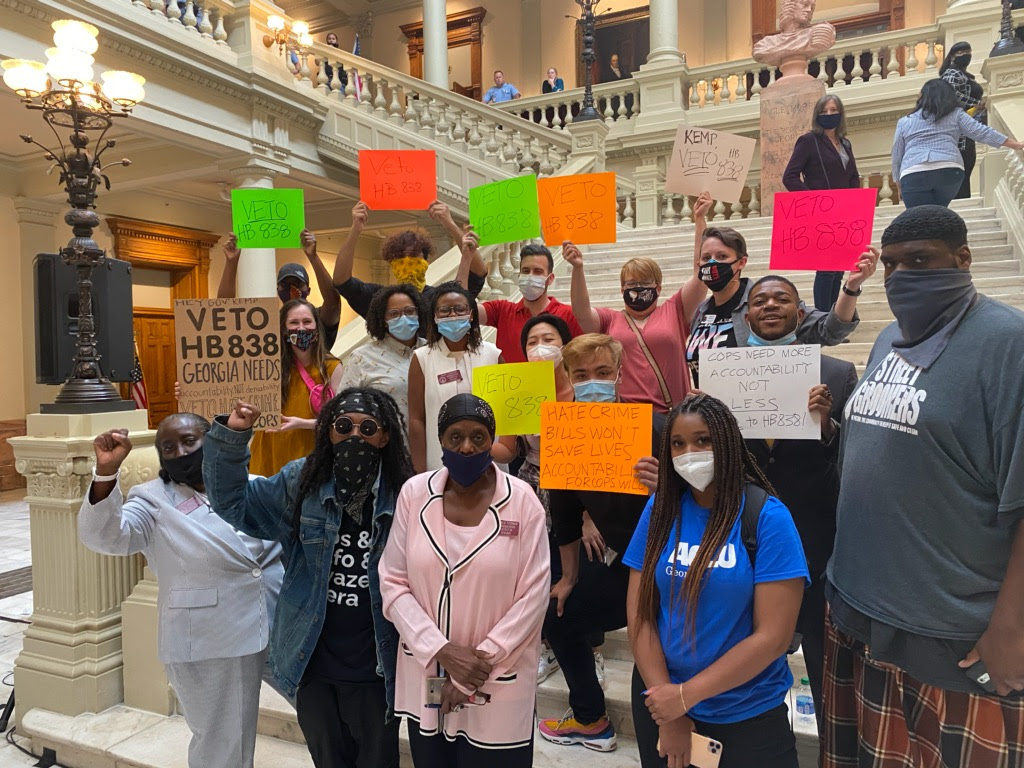
And that was only Tuesday! The Hate Crimes legislation was signed into law by the Governor on Thursday, among a crowd of supporters, and demonstrators holding signs that said, “Veto HB 838.”


The Rest of the Week

Bills that Passed

HB 793, The Budget: I voted no. A conference committee of House and Senate members worked through their differences, and both chambers ultimately approved the compromise, fulfilling our only Constitutional duty. But I could not vote for a budget that cuts school funding by $950 million and severely underfunds other critical services such as mental health and disabilities. Remember that these deep cuts were necessary because of a budget that was in disarray before the pandemic thanks to irresponsible Republican tax cuts. We’re already seeing the effects of an understaffed Department of Labor that can’t keep up with unemployment claims, a disturbing issue I raised at the Senate well this week and something I plan to work on in the interim.

HB 1114: I voted yes. This bill provides six months of Medicaid coverage to new mothers following childbirth as well as Medicaid lactation services. Georgia’s maternal mortality rate is one of the highest in the country, with black mothers dying at even higher rates than others. This was a big win for the Georgia Legislative Women’s Caucus, which I have chaired for the last two years. 19.7 million dollars was allocated in the budget for this coverage. This is one tiny step toward Medicaid expansion.

SB 359: I voted no. This bill shields business from COVID-19-related liability. It requires the claimant to prove gross negligence, which is extremely difficult. Though businesses might fear lawsuits, it would be very difficult to prove where a person “caught” COVID-19. This law could disincentivize business and other entities from taking necessary steps to protect their employees and customers from COVID-19.

HB 879: I voted yes. I know many of you will like this one! It allows for expanded home delivery for alcohol. As an aside, April revenues showed a dramatic increase of alcohol sales tax during the Shelter-in-Place Order.

SB 416: I voted yes. It cuts legislator Pay by 10%. Legislators make $17,350/yr in addition to per-diem for several Committee days throughout the year.

HB 857: I voted yes. This prohibits burning railroad ties treated with toxic creosote, with some exceptions. This bill passed both chambers unanimously.

SB 375: I voted yes. This bill raises the age to buy tobacco and vaping products to 21, and adds a 7% tax to vaping products (Georgia currently has no vapor excise tax). No action was taken to raise Georgia’s tobacco tax, which is one of the lowest in the county. Several research groups and advocacy organizations have noted that increasing the tobacco tax could help address our revenue shortfalls this year due to the pandemic.

HB 987: I voted yes. It improves staffing, training and accountability at long-term care facilities. In amendments added by the Senate, it requires senior care homes to plan for a pandemic, have a supply of PPE, and to notify residents and family members of a COVID outbreak.


Bills and Ideas that Died on the Vine

HB 463The Elections Bill”: This was the elections bill that began in 2019 in the Senate. The House stripped all the language from the Senate bill and added new language that included banning governments (state, counties and municipalities) from being able to mail out absentee ballot request forms. This was an overt attempt at voter suppression during a pandemic.

HB 765Magistrate Judge Salaries”: This bill would have raised salaries for magistrate judges 21.6 percent. Yes, you read that right — “raise” during the worst budget crisis since the Great Recession. Someone in the Senate really wanted those raises, because we wasted a considerable amount of time debating this bill on the floor of the Senate. It got tabled, then removed, amendments failed, and then, it finally passed the Senate amended with an enactment delay of two years. I voted no. The House, which moved slower because they took social distancing much more seriously than the Senate, ran out of time to act on the Senate version, so ultimately the bill did not pass.

Gambling: There was a lot of talk about passing enabling legislation to allow for sports betting, casinos and pari-mutuel betting. None of these bills passed this session.

Revenue Enhancements: There was also a lot of talk about ideas to generate revenue to plug the holes in the budget, including rolling back special-interest tax breaks, revenues from gambling, and raising the tobacco tax to the national average. But for the most part, none of these happened. In 2018, the legislature passed a huge income tax cut based on expected revenue that never materialized. There was zero talk about reversing this tax cut, yet this tax cut is a big part of why we are having to cut things like public education by another billion dollars.

HB 906, Ossabaw Island: This bill sought to amend the Heritage Preservation Act of 1975 by allowing up to 15 acres of property to be transferred to local governments and “business entities.” Currently, Ossabaw Island is protected under a 1978 Governor Executive Order that only allows recreation that promotes research, education and preservation. Follow the Georgia Conservancy for more details.

Peachcare Public Option Study Committee: This year, I filed SB 339, that would create a plan for a Medicaid Public Option. The bill was assigned to the Senate Appropriations Committee, and Chairman Jack Hill not only allowed me to present SB 339 to his committee, but he also wrote me a letter saying that he believed it to be a worthy idea and would support a study committee to conduct an actuarial analysis of such a plan. Sadly, Republican leadership did not allow that study committee to move forward. I will re-file this bill next year.


Looking Ahead

We have big challenges ahead. COVID case numbers are on the rise. Schools and universities will be returning to classes in some form or another soon. Our unemployment system must be overhauled to prevent food and housing insecurity. Our hospitals must remain vigilant to prepare for surges of patients.

Now, more than ever, we need a functioning government at local, state and national levels.We need leaders who believe in the power of government to serve and support our communities. We have four months to ensure that we can carry out an election in the midst of a pandemic, and we must force our leaders to do what’s right for democracy.

I pledge to you that I will be working every day in the coming months to embrace all these challenges. Help me to be part of the solution by donating to my re-election campaign if you are able. Every little bit helps!


Pictures from week 12 of the 2020 Legislative Session
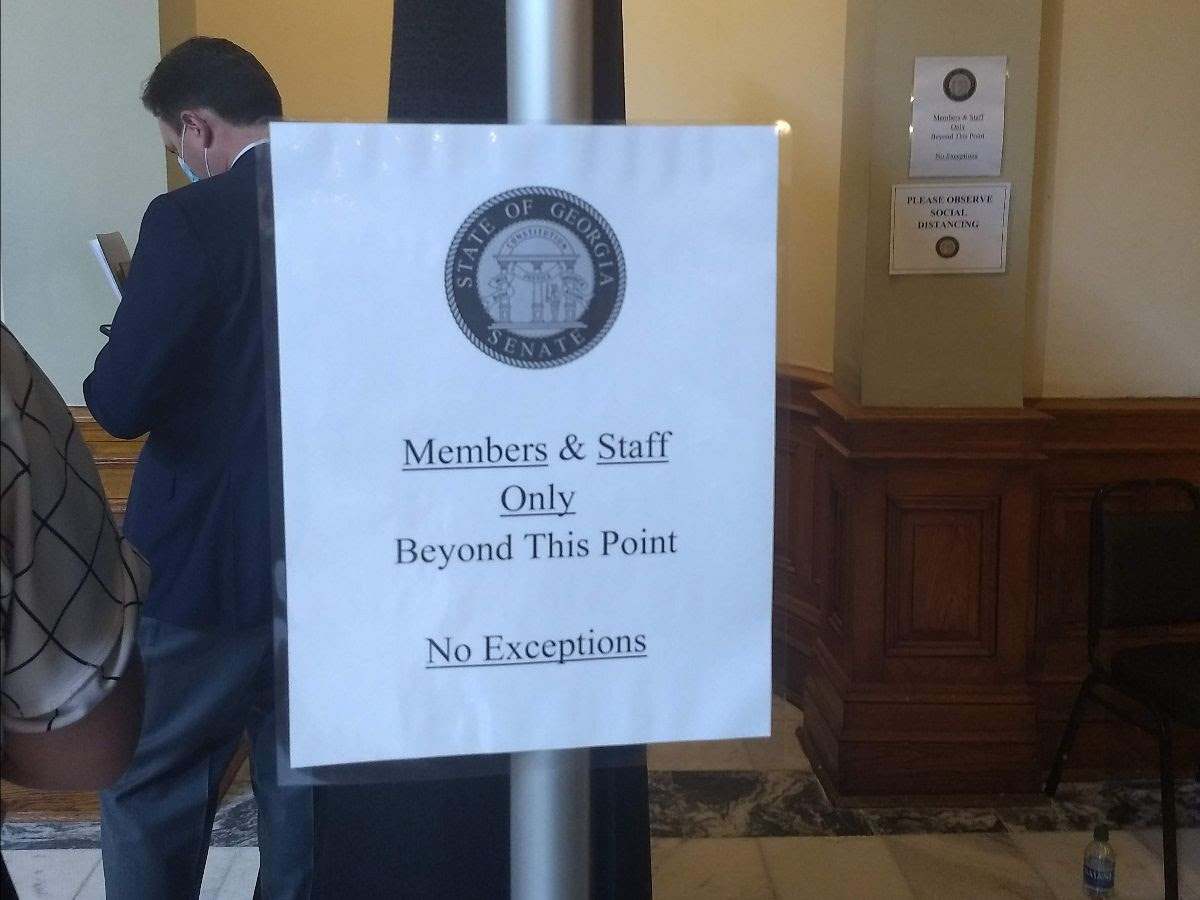
This is where the rope line used to be, where Senate pages sat and Senators greeted constituents
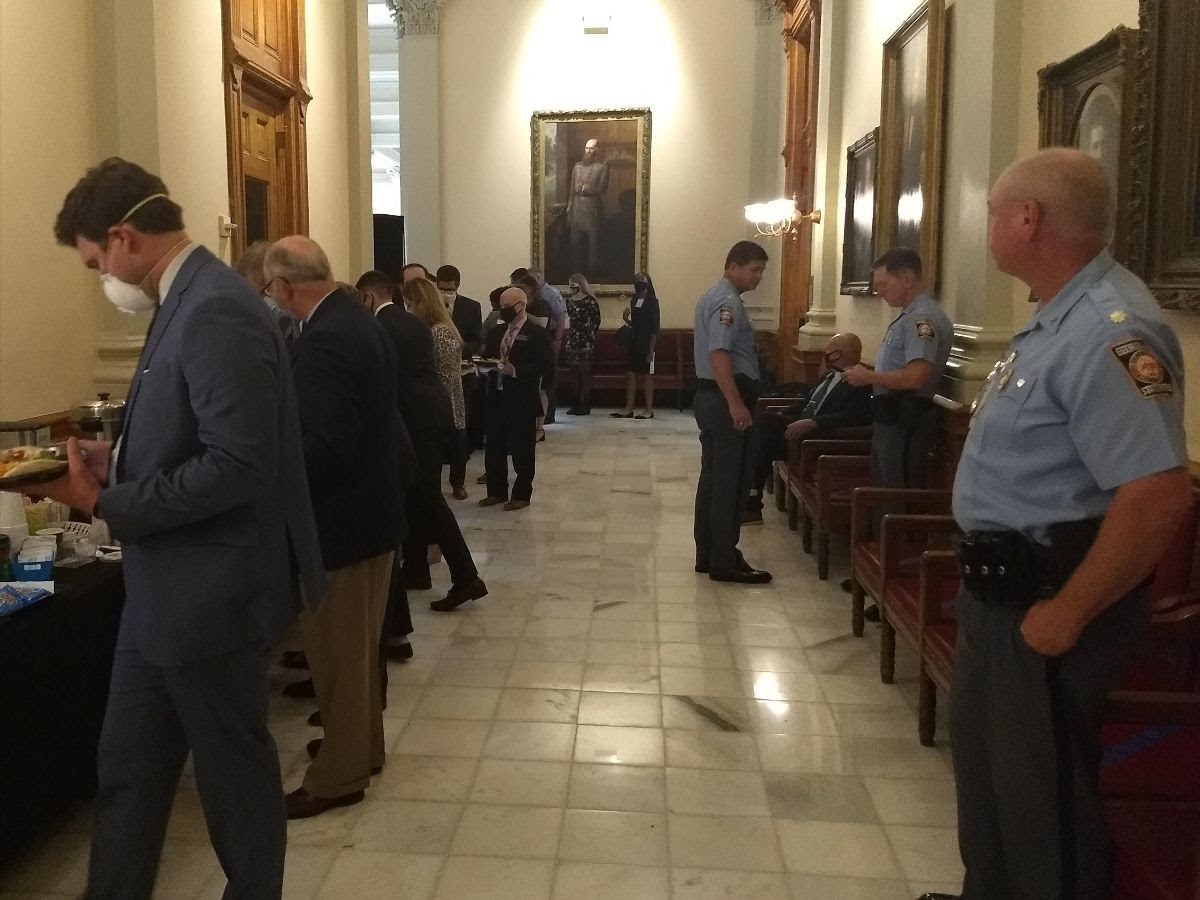
On Thursday, the Senate served a buffet-style lunch (which I did not eat). Social distancing was not observed. Law enforcement officers declined to wear masks all week.
Protesters ask for the police bill, HB 838, to be vetoed by the Governor. Call Governor Kemp at 404-656-1776 and ask him to veto HB 838.
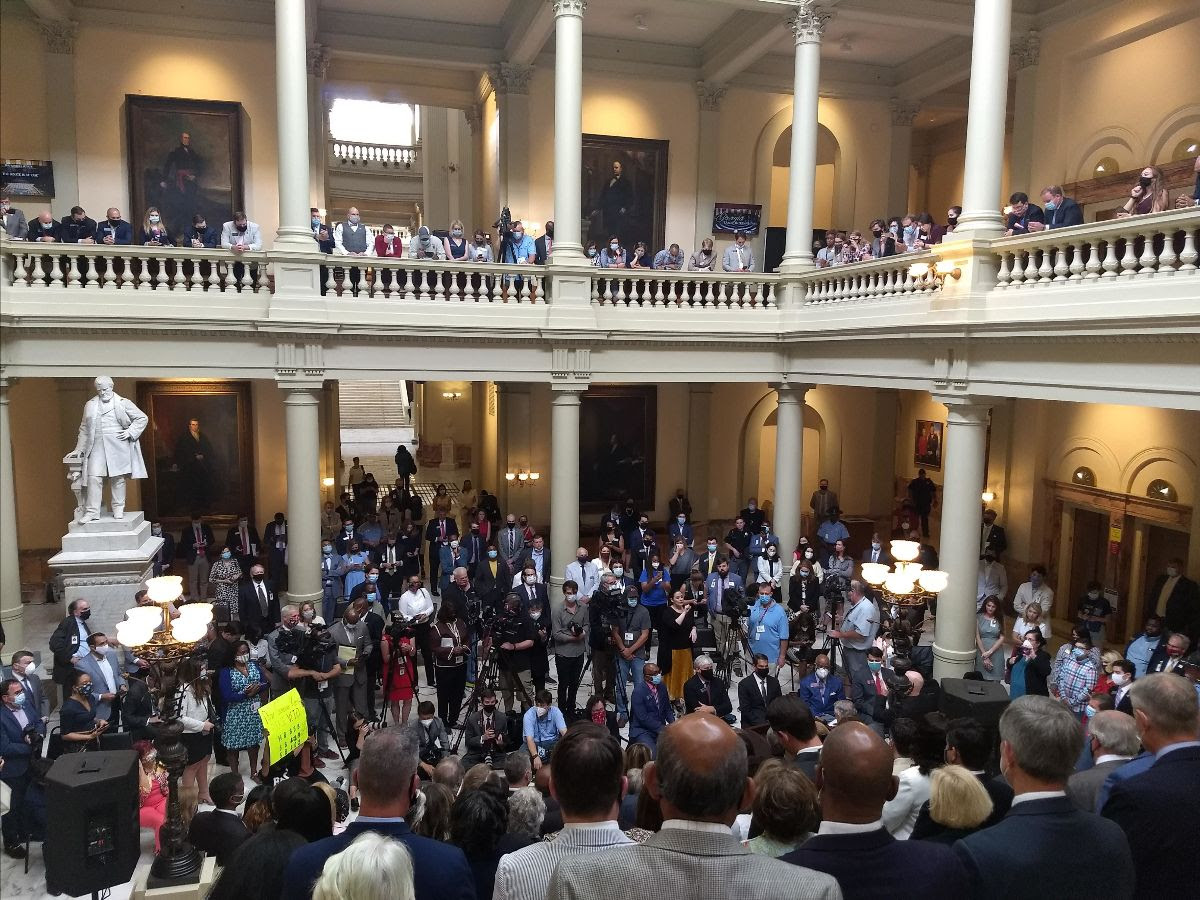
Hate Crimes Bill Signing: A crowd of people gather at the Capitol for the signing of HB 426, the Hate Crimes bill.
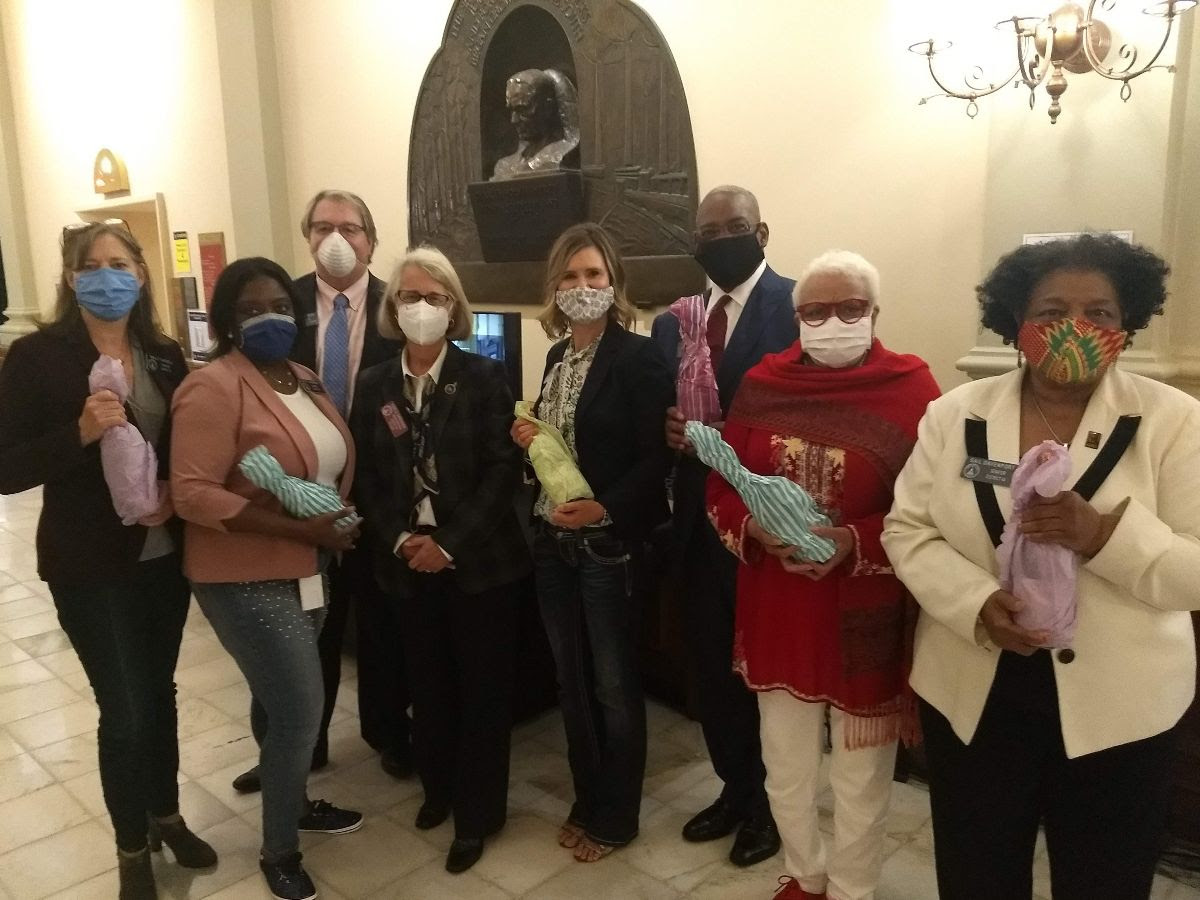
DeKalb Ethics Bill: Rep. Karla Drenner gives all the DeKalb Senators a gift of champagne for passing revised DeKalb Ethics Legislation after voters rejected the 2019 bill.
Sine Die: The House did not allow confetti throwing and kept social distancing rules all week. I left the chamber quickly, because people were wanting to give me hugs.
Senator Sally Harrell, Georgia Senate District 40

This Father’s Day, I remember how proud my dad was when I won my election to the Georgia Senate, but if he were with us today, he would have been ringing his hands at the thought of me returning to work.

It was a rough week at Georgia’s State Capitol. After three months of mostly staying at home to avoid Covid, and the Atlanta shooting of Rayshard Brooks the weekend before, the agitation in the air had me pretty nervous about returning to the Capitol. Plus, I wondered which bills the majority party would choose to act on, given the hundreds of bills that would remain on the table due to the difficulty of legislating while observing physical distancing rules.

Monday morning there were police everywhere —  even on the roofs of buildings. Since police presence was not as intense the rest of the week, I can only assume they were there due to a NAACP march that culminated at the Capitol at 10 am.

I took a little walk around the Capitol Monday morning to watch the NAACP march. Unfortunately, I missed the rally, but I was so happy to see and talk with lingering attendees back inside the Capitol, affirming that it truly still is the People’s House.

The Best Laid Plans Go Awry

The careful protocols the Senate established to keep legislators and staff physically distanced from one another all went out the window first thing Monday morning when many members of the Republican Caucus decided to ignore the rules.  To limit the number of people in the Senate chamber, most Senators were supposed to watch the session from their offices or on Capitol grounds until it was time to speak or vote. By Tuesday, I realized they weren’t giving us enough time to get to the chamber and back between votes, so most of us eventually gave up and remained in the chamber.

While the majority of Senators wore masks, some Republicans outright refused. I noticed that many lobbyists and all the police went without masks. When I asked them about it, they didn’t offer good answers. I was so frustrated that I went to the Senate well on Friday (video) to remind my colleagues that wearing a mask is a science-based way to protect each other, and a necessary measure for our police force to keep all of us, members of the public, and our families safe.

Georgia’s Bare Bones Budget Gets Slashed Again

HB 793, the FY 2021 General Budget, came to the Senate floor on Friday. It called for painfully deep cuts in essential services, including a $1 billion cut to local school funding, a $122 million cut in Behavior Health and Developmental Disabilities funding, $127 million in Public Health and Human Services, $250 million less for Georgia’s universities and colleges and $40 million less for our technical schools.

In March I gave the late Sen. Jack Hill, Senate Appropriations chairman, the courtesy of informing him that I would probably vote against the budget. He replied by telling me that it’s a long-standing tradition for the Senate to pass the budget unanimously, and instructed me that “We must govern.” I am proud to report that not a single Democrat voted for this budget. We understand the steep financial challenges we face due to the pandemic, but we also can no longer ignore the bad decisions that made a terrible situation so much worse. Well before the pandemic, years of tax cuts, special interest tax breaks, a refusal to expand Medicaid, and the defunding of critical programs have left us with severely underpaid state employees, underfunded schools and mental health services, and an unconscionable number of uninsured Georgians. Georgia’s Quality Basic Education (QBE) funding formula had been consistently underfunded since the early 2000s. Often these “temporary” cuts become permanent. Georgia can’t afford another lost decade of under-serving its communities.

Another important “no” vote this week was my vote against confirming the Governor’s 200 or so board appointees. These individuals have mostly been chosen, sworn in, and are already doing their jobs, so confirmation by the Senate is basically a “rubber-stamp” vote, and I wasn’t elected to be a rubber stamp. Plus, many of the appointees govern with values very different from the values I campaigned on, and their positions will continue to shape education, social justice, healthcare and many other policy areas for years to come.

The Hate Crimes Bill Takes a Troubling Turn

In my last email I mentioned that there might be some back and forth between the House and the Senate about HB 426, the Hate Crimes Bill. Sure enough, by mid-week, the Lt. Governor announced a new version. There were some good things in his bill, but also some very bad things. The Speaker of the House objected to the bill and urged the Senate to pass the House version.

By Friday, following behind the scenes negotiations, instead of advancing the Lt. Governor’s bill, the Senate Judiciary Committee considered the House version of HB 426 but added law enforcement as a protected class of citizens. After a heated debate, it passed in Committee along party lines. It immediately drew ire from the Georgia NAACP who went from supporting it to strongly opposing it. Law enforcement officers are an important group of people who perform a difficult and valuable public service. But law enforcement already enjoys special protections in existing state laws. Senator David Lucas said it well (watch video).

The Hate Crimes Bill is expected to be on the Senate floor on Tuesday and the Senate Democrats will stand strongly united against it in its current form. Please take time before the bill comes to the Senate floor on Tuesday to call or email all the Senate Republicans to tell them to remove occupations from HB 426.

Legislative Highlights

I’m proud to join my Democratic Caucus in signing the Georgia Justice Act, a slate of 10 bills that have now been bundled together to create sweeping criminal justice reform. The Act includes reforms that had previously been introduced and adds new measures to address recent issues.

Some other noteworthy bills that moved forward this week:


    • The Senate passed HB 888 which would reduce surprise hospital billing by requiring insurers to cover certain care regardless of whether the provider was in or out of network, and prohibits certain balance billing. I voted yes.


    • The Special Judiciary Committee heard HB 903, originally a short traffic citation bill that was “hijacked” with new language calling for a referendum to potentially allow on-line sports betting administered through the Georgia Lottery, which could then allocate 20% of proceeds to Pre-K and the HOPE Scholarship. I voted against the bill. The Georgia Lottery has not experienced an economic downturn, so current funding for Pre-K and the HOPE Scholarship are not in jeopardy. For government services that benefit all Georgians such as education, I prefer progressive tax structures.


  • After a very lengthy debate, HB 545, passed largely along party lines. The bill severely limits the conditions and time-frame that an agricultural operations facility can be sued for nuisance. I voted no.

What’s Coming Up:

This week we were in session Monday – Saturday. Next week we are currently scheduled to be back in session all week, ending the session, Sine Die, Friday, June 26th.

Some of you might have noticed that I have not asked for campaign contributions for over six months. This is not because I don’t need the money, but because the Georgia Ethics Commission chose to interpret Georgia law banning fundraising during session to include the “suspended” session for the last three months.

I do have Republican opposition in the November 2020 election, so if you have appreciated these emails and are able to make a contribution, you can do so after June 26th. At that point, I will need all the help I can get! Thank you in advance for your consideration.

Voting “No” on the budget
Protester beside confederate statute
Bad examples of mask wearing
Signing the “Georgia Justice Act”
Crowded Senate Chamber

Back to Work, 2020 Style

On March 12th, 2020, the legislature was suspended on day 29 of a 40 day session. On June 15th, three months later, the Georgia General Assembly will return to work to finish the last ten days of the legislative session.

How the Next Ten Days Will Work

During the time between when I served in the House and when I was elected to the Senate, I occasionally had a dream that I was back in the legislature, but instead of sitting in the chamber, I was relegated to the “overflow” room.

For the next two weeks, until Sine Die, I will literally be in the overflow room, watching the session through video streaming instead of my seat in the chamber. In order to adhere to physical distancing, only designated leaders of both Parties will actually be in the chamber. If we want to speak, we must notify the leadership, entering the chamber only temporarily. We will be called in to vote in small groups. Like one-way grocery store lanes, there’s a diagram showing us where we enter, the direction we walk, and where we exit.

There will be no student Pages, no special presentations, and the press will be in the gallery instead of the people. There will be no rope line to greet constituents, and, of course, no hand shaking. Those who want to watch democracy in action will have to do so through streaming on the internet. Committee testimony by the public will be limited due to lack of space.

Debate, both by the people and the legislators, will be severely limited. While this new way of getting our work done might be necessary, it is not good for democracy. Let’s hope it’s short-lived; let’s get through the next ten days; and then get busy on those November elections!

Finishing the Work of the 2020 – 2021 Georgia Budget

The state budget begins in the House: According to Georgia’s constitution, the state budget must begin as a House bill, and prior to the suspension of the session, the House passed its version of the budget and sent it to the Senate. But now the state’s projected revenue is at least 11% lower than the revenue estimate the House based its budget on — so for all practical purposes, the budget process must start over — in the Senate. For the last three weeks, the Senate Appropriations Committee has been hearing testimony from State Department heads, who were ordered by the Governor to cut budgets by 14%. In watching these hearings, it’s clear to me that Georgia currently lacks the revenue it needs to do what it is mandated to do. But still, according to Georgia’s constitution, the legislature must pass a balanced budget. The Governor, in consultation with the State Economist, will set a revenue estimate, and the legislature must budget within that estimate. If we had national leadership, I believe at this point the federal government would be bailing out the states, as states cannot “print money” as congress can. Without federal help, or without a tax increase, schools across the state will lose another 1.5 billions dollars, on top of the 9.2 billion they have lost since the 2008 Great Recession. Georgia cannot afford another lost decade.

Moving the Hate Crimes Bill

It is clear from the number of emails I have gotten that the people of Georgia want a Hate Crimes bill to pass. And I am very hopeful that this will happen before the last day of the 2020 session.

Many people have also communicated with me that it’s not enough just to pass a Hate Crimes bill — that we need additional legislation addressing police brutality and the repeal of laws such as Stand Your Ground and Citizen Arrest laws. I agree. But because it is past Crossover Day, according to the legislative rules, we can no longer act on bills that haven’t passed their respective chamber. While rules can be waived, they cannot be waived without the support of the Majority Party, which we do not have at this time. The Democratic Party in both the House and the Senate have unveiled legislative packages that can be acted on when we reconvene in January 2021, following the November elections.

We are able to pass the Hate Crime bill, HB 426 now, because it already passed the House with bipartisan support. Until now, the Senate Judiciary Chair, Sen. Jesse Stone, has refused to hear the bill in the Senate Judiciary Committee. But due to the upset over the brutality in the murder of George Floyd, and now the Atlanta police murder of Rayshard Brooks, and your emails to Sen. Stone, the political environment has changed. On the second night of the Atlanta demonstrations, Lt. Governor Geoff Duncan placed personal phone calls to members of the Senate Black Caucus, asking for their input on what needs to happen. Shortly after, he released a statement calling for the strengthening of HB 426.

Expect there to be some back-and-forth between the House and the Senate on the Hate Crimes bill. Many are asking for the bill to be passed unchanged, but some say the bill as passed by the House is weak. If HB 426 is changed by the Senate, it must be voted on again by the House, as they must agree or disagree with the Senate changes. Because HB 426 passed the House narrowly, House members are concerned another vote could jeopardize the passage of the bill. But clearly, the political climate has changed since the House voted on HB 426. The Republican leadership in both the House and Senate now want this bill to pass.

Why is HB 426, as written, weak? Because it is merely a penalty enhancement bill, which would put it among the five states with penalty-only statutes. In addition to penalty enhancement, other states include independent crime offenses, training, data collection and civil action. Incidentally, Georgia already has statutes on two independent crime offenses, including crossing burning (O.C.G.A. 16-11-37) and church vandalism (O.C.G.A. 16-7-26).

The Lt. Governor, who presides over the Senate, said in his statement that he would like to add training and civil action to HB 426, which would make the bill somewhat stronger.

The purpose of any law is to create an awareness of the parameters that society will tolerate, and to set penalties for behavior that cross these lines. In that regard, passing any kind of Hate Crimes legislation in Georgia is a huge symbolic step forward, and will create the positive momentum for bringing about further change.

Looking Ahead

If the June 9th Democratic electoral turnout is predictive of November elections, we will take additional seats in both the Georgia House and the Senate to help pass these “Justice” bills next year. Picking up 16 seats in the House would end the Republican majority and the political gerrymandering they are planning in order to rig the system for another decade. An increase of five seats in the Senate will close the gap, slowing the far-right agenda and putting Georgia back on the track of progress. We have great candidates in all those districts, so let’s support them, and give Georgians a reason to go vote!

Demonstrations and protests during a pandemic are unsettling. Many have asked me, “what can we do?” To start, we need to listen to black people. Last week, my neighbor Deontez Winbley published an essay on Georgia Public Broadcasting’s news website about the need to be uncomfortable, and he has given me permission to reprint it here.  Please hear what Deontez has to say. After reading, I hope that you’re motivated to do more, and there are some calls to action at the end of the email. –Sally


The recent protests in response to the death of George Floyd have sparked a lot of discussion, activism and social unrest. I write this to provide what I believe is necessary context and perspective. —Deontez Wimbley

THE WHY

I would like to believe that everyone understands why this weekend happened, but I do not want to rest on that assumption. People are BEYOND tired. Literally since 1619, Black people in America have been working generation after generation to be treated like human beings. Unfortunately, federal and local policies have not been sufficient at achieving that goal. The discontinuation of the trans Atlantic slave trade did not do it. The signing of the emancipation proclamation did not do it. The 13th, 14th, and 15th amendments did not do it. Brown v. Board did not do it. LBJs civil rights legislation did not do it. The 1990s crime bill set us WAY BACK. And even electing America’s first Black president DID NOT DO IT.

At this point people are wondering what is there to do. I do not want to be misinterpreted as thinking these vital pieces of policies did not do anything, but they did not fully achieve the goal of Black people being treated as full humans in this society. So the first purpose of the protests is to work towards raising public consciousness on the value, beauty, and humanity of Black people.

The protests were designed to deliberately disrupt the comfort of this city and ultimately this nation. In disrupting the city’s comfort, the city is forced to evaluate its consciousness.

THE HOW

There has been considerable discussion about the rioting and looting. Let me be clear. I did not participate in the rioting and looting and I do not think that such actions are the answer. I do want to offer a perspective on why some feel it is. For far too long there have been people who have cocooned themselves in the comforts of their luxury homes, turning a blind eye to the injustices faced by people a few blocks away. The means many believed will wake them up is to do strategic destruction.

From downtown to Buckhead, everyone is thinking about black life, suffering, and injustice, and that matters. Today, folks can’t just run to Lenox and the CNN center to continue to ignore injustices in the world. They have to pause. They have to reflect. The city has to wonder how to rebuild from this. The comfortable have been afflicted.

We see how quickly Mayor Bottoms terminated the cops for excessive force on the two AUC students. This is the result of protest. The ten tolerance is slowly making its way to zero tolerance. You know what is taking it there? Voting didn’t do it. A petition didn’t do it. Volunteering at a shelter didn’t do it. DISRUPTION is doing that. CHAOS is doing that. PROTEST is doing that. Let me be clear. I vote in EVERY election. I sign petitions AND volunteer with my community EVERY WEEK. But I know this is not a one solution issue. These measures happening are going to wake up this nation and make all of us uncomfortable.

THE PROTESTS

The overwhelming masses of protesters DO NOT believe in rioting and looting. They simply want to be heard and seen. Anyone who thinks otherwise, is being disingenuous. Young people DID listen to the voices of the mayor, Andrew Young, and other members of older generations.

Look at the actions that took place on the 17th street bridge Sunday evening. It was strategic. It was unified. It was disrupting. I will even say for many, it was cathartic. I call on elected leaders, public intellectuals, journalists, clergy, business leaders, and others to listen to our voices, take seriously our concerns, and work on a multi-pronged platform to lead us to liberation.

I call on white people to do some deeply uncomfortable introspection, examine unconscious and conscious biases, and have conversation with each other about the “isms” that are so rooted in their hearts and minds. White supremacy is like rain. It drenches us all. It just drowns some, while others get to float.

Deontez Wimbley lives in Senate District 40 in north DeKalb County and works as a health educator.

He says about himself, “I am a millennial born and raised right here in Atlanta. I am a PROUD Grady baby, and I am a PROUD Black, Gay man.

This essay was originally published by GPB at https://www.gpbnews.org/post/opinion-protests-are-needed-disrupt-our-comfort, and includes audio of Mr. Wimbley reading his essay.


What Can I Do? — Calls to Action

Help pass HB 426, Georgia’s Hate Crimes Bill. The bill is stalled in a Senate Committee.  Call or email the following people and ask them to move the bill to the floor for a vote. While you have them on the phone, also ask them to repeal the “Citizens Arrest”, and “Stand Your Ground” laws.

  • Lt. Governor Geoff Duncan: (404) 656-5030; https://ltgov.georgia.gov/contact-lt-governor
  • Senate Judiciary Chair Jesse Stone: (404) 463-1314; Jesse.Stone@senate.ga.gov
  • Senate Pro-Tem Butch Miller: (404) 656-6578; Butch.Miller@senate.ga.gov
  • Majority Leader Mike Dugan: (404) 656-7872; Mike.Dugan@senate.ga.gov

Passing a Hate Crimes bill is a big step for Georgia, but we must also address police brutality head-on. In 2015, following Michael Brown’s murder in Ferguson, Missouri, President Obama convened a Task Force on how to prevent police brutality. The final report, “The President’s Task Force on 21st Century Policing”  provides a roadmap that is still very useful and relevant today.

Based on the 21st Century Roadmap, Campaign Zero has continued to provide research-based action steps for eliminating anti-blackness and police brutality. Use this site to educate yourself on what kinds of things can be done at the federal, state, and local levels.

Like many of you, I watched as Atlanta and so many other cities across the country erupted with raw rage and grief at the racist murders of black men and women. The murderers who committed these crimes did so with the knowledge that our justice system is rigged to protect them.

Let that sink in. We ask people of color to trust their lives and freedom to the government, to the police, to their neighbors, and we betray them again and again and again.

Racism is so deeply ingrained in our communities that sometimes it stares us in the face and we don’t even see it. Grady Memorial Hospital, for example, is named after Henry W. Grady, who publicly stated in 1888 that, “The supremacy of the white race of the South must be maintained forever.”

Last December, a group of Georgia State University students asked for the downtown statue of Henry Grady to be relocated to the Atlanta History Center. Their activism hit a brick wall when they learned that the legislature’s majority party had recently passed a law making it illegal to relocate most monuments. Instead, the students had to settle on asking for a contextual plaque to be placed on the statue. To my knowledge, that plaque has never been placed.

In two weeks, the legislature will convene to finish the 2020 legislative session, and I am committed to pushing forward the stalled Hate Crimes legislation, HB 426. It passed the House with bipartisan support and currently is being held up in the Senate Judiciary Committee by Committee Chair Sen. Jesse Stone. Sen. Stone lives in the same small town of Waynesboro where Ahmaud Arbery is now buried.

Passing and implementing a Hate Crimes bill will not end racism – that is a complex issue whose roots lie deep.

But passing the Hate Crimes Bill will give us one more tool to reject and penalize racist actions.

Black lives matter. The anger and pain black people and other communities of color feel right now matters.

For our society to find healing and peace, those of us in powerful and privileged positions have to earnestly and in good faith rebuild a trust that we have repeatedly broken.

We all can start this work in a small way today.

Email or call Sen. Stone (jesse.stone@senate.ga.gov or 404-463-1314) and demand that he move the Hate Crimes bill out of the Judiciary Committee with his full support for its passage in the State Senate. Tell him to do this in memory of his neighbor, Ahmaud Arbery. Tell him to do this because the loss of black lives matters.

Red Poppy

My grandmother, born in 1894, was active in the American Legion, so my mom carried on that tradition. I remember going with mom to our local bank to hand out paper poppies, handmade by veterans to raise money for veteran healthcare. Mom taught me to approach the businessmen by saying, “Poppy, sir?” The gentleman would hand mom some spare change, putting the poppy into the buttonhole on his lapel. Photo Credit: Marc Merlin

The poppy, like Memorial Day, reminds us to reflect on the legacy of our fallen soldiers. But this Memorial Day weekend the Boy Scouts aren’t out putting flags on graves. Kids have already been out of school since March. And families aren’t excitedly waiting for the gates of swimming pools to swing open so they can take their inaugural summer splash.

Like many of you, I’ve been “sheltering” for about two months. As a friend says, “I can only think four weeks at a time.” So we’ve been at this about 8 weeks, two four week “chunks”, and we’re about to start a third chunk. Time to take stock.

Some Really Good Stuff

Last March, I wrote that we have all “the right stuff” to get through this. Some of that “stuff” is beginning to reveal itself:

Bringing it all together: South Georgia farmers have been hit hard. School and restaurant closures mean no one’s buying their crops. Bring together those farmers, DeKalb county, $40,000 of federal CARES Act money, and you get 600 boxes of Georgia-grown produce and 600 boxes of frozen chicken distributed to families in need. Bringing it all together means crops don’t get wasted and people don’t go hungry.

COVID Treatment: Two treatment options for hospitalized COVID patients are showing promising outcomes, antibody blood plasma treatment and the antiviral medication Remdesivir. Georgia has received two free shipments of Remdesivir. The first went out to eight hospitals, treating 110 patients; the second to 29 hospitals for 310 patients.

A New Vote-by-Mail System: As Georgia’s Secretary of State, Brad Raffensberger, said during a recent conference call with legislators, “It usually takes 6, 7 or 8 years to put a (Vote-by-Mail) system like this in place.” Utilizing Georgia’s existing absentee ballot program, almost half-a-million people have already cast their ballots by mail for the June 9th primary. Georgia received 10.8 million in CARES Act dollars designated for elections. The scary thing is that seven million dollars have already been spent (4 million on printing and postage alone), and we still have the November election to get through, when many health professionals are predicting a second wave. Call your congressperson and tell them we need federal assistance to continue Vote-by-Mail in the November election.

You still have a little more time to request a ballot if you do it quickly! Secretary Raffensberger said they are now processing Vote-by-Mail applications in “real” time (2 – 4 days). Print the application, fill it out, and either mail it or email it to your local elections office. If you don’t have a printer, or if you have any questions regarding voting, call the Voter Protection Hotline at 1-888-730-5816. 

Early In-Person Voting has started. Click here for early voting hours and locations. Gwinnett county posts polling place wait-times on-line!

Click here for Vote-by-Mail Dropboxes. Click here for dropboxes in DeKalb. If you choose to mail your ballot, I’m told you generally need one stamp, but two for Gwinnett (Gwinnett’s ballot is longer since it’s printed in two languages).

The Democratic Party of Georgia advises Voting-by-Mail for your safety. Also, the Secretary of State’s office is asking people who started the Vote-by-Mail process to stick with it, if possible, rather than switching to in-person voting. If you show up to vote in person after requesting a ballot, a poll worker must cancel that ballot, which takes time and leads to longer lines. If you have an absentee ballot and need to vote in-person, it helps to bring the ballot with you (although this is not mandatory).

Room for Improvement

Test Kits: Georgia continues to work on ramping up testing, with over 100 test sites now located across the state, and 200,000 test kits promised from the feds (30,000 have arrived). Unfortunately, Georgia has been artificially inflating test numbers by including antibody tests in the totals. (More about this below). It is currently recommended that 2 percent of the population be tested every month. In DeKalb that means we should be testing 15,000 people per month. Clearly, we have a long way to go. DeKalb’s Board of Health director reports we don’t even have a system in place in DeKalb to know exactly how many are being tested, because we don’t yet have a county level sharing platform. Some businesses, such as Emory and MARTA, have begun doing their own testing, which is not recorded in any official capacity.

Contact Tracing: The State’s Contact Tracing program has hired and on-boarded 500 tracers. These tracers are now following 3300 COVID positive individuals and 9000 of their contacts. By mid-June they will have 1000 tracers. Johns Hopkins estimates needing 7 tracers per 100,000 people. The State has promised DeKalb 60 tracers, slightly above the recommendation.

Quarantine: COVID-positive people are asked to quarantine at home, but many people do not have a way to isolate themselves at home, and live with vulnerable family members. This week, I spoke with Insurance Commissioner John King, Doraville’s former Chief-of-Police. Gen. King is heading up the response in Hall county’s hotspot. I’m happy to report that Gen. King has secured the floor of a hotel for quarantine space. However, Gen. King said it’s hard to convince people to use it. Many of Hall county’s COVID positive people are young males who work in the poultry plants and are asymptomatic. They just don’t see the need to quarantine. As Gen. King said, preventing spread of the virus is all about getting the message out through people who are trusted and known in a community. The key word is trust. None of this works without trust.

The Really Ugly

Data Manipulation: Speaking of trust, last week the Governor’s office came under fire for manipulating data to make it look like cases had been in decline for two weeks. This week they were under fire again for including positive antibody tests in the numbers for total tests, making it look like we are testing more people than we are. And as if that’s not enough, I’ve noticed that my calculated hospitalization numbers have not shown the drop the Governor’s office reported this week. In fact, my hospitalization totals, calculated from the cumulative totals on the Dept. of Public Health website, have increased during the last week. The Governor’s numbers do not include people who are “under investigation for coronavirus.” And according to NBC news, even if they had a positive COVID test before being admitted, they are still “under investigation” until they have a hospital administered positive test. With labs backed up, it’s quite possible that some people could be discharged before test results return. A quote from the Scottish poet Andrew Lang seems apropos: “He uses statistics as a drunken man uses lamp posts — for support rather than for illumination.”

Hospital Lay-Offs: Much has been said about how we need to protect our healthcare workers. But now that the surge is over, instead of getting a little rest, healthcare workers are being laid off. This is because hospitals are reporting losses of hundreds of millions. Patient volumes are down. Emergency rooms are at 34% utilization, way down from normal, and people are coming in more sick due to delayed care. In-patient beds normally stay 80 – 90% full, but they are down at least 25%. In a for-profit healthcare system, these losses are not considered sustainable. What if our nurses, already in short supply, decide it’s just not worth it, and leave the profession? Without them, we are toast. A for-profit healthcare system during a pandemic is not sustainable.

The Opportunity

COVID is about to break our healthcare system. 

Georgia’s unemployment rate hit 11.9% in April. More than one out of every ten workers is without a job, worse than anything we saw during the Great Recession. Many of these workers have also lost their health insurance. In 36 other states, these workers can sign up for Medicaid, but not in Georgia, because we did not expand Medicaid. When you see underutilization stressing the financial viability of Georgia hospitals, you are seeing the effects of people afraid to seek care. Not because they’re afraid of catching COVID, though many are, but because they know they can’t afford the care. If you end up hospitalized with COVID, it will cost you an average of $78,000. How many people have that much spare change?

We can create policy that takes the profit out of healthcare. We can expand Medicaid in Georgia. We have an election coming up this November and it’s a big one. Get your friends to vote like their lives depend on it. Because they do.

Healthcare Heros

Action One:
Help Someone Apply to Vote-by-Mail

This week is “Vote-by-Mail Week”, and the Democratic Party of Georgia (DPG) set a goal of helping 70,000 voters apply for Vote-by-Mail ballots. On Friday they had already assisted 67,859 people, so they increased their goal to 80,000. Help blow-the-top off their goal by reaching out to people you know today.

Each person you get to apply for Vote-by-Mail this week will be more likely to Vote-by-Mail in November, which will help us deliver the votes to defeat Donald Trump. The DPG has on-line resources that explain how to Vote-by-Mail.  Check them out — I especially like the video!

Voter Protection Hotline: 1-888-730-5816: Applied, but haven’t received your ballot? Can’t find a ballot dropbox? Call this hotline for any questions related to voting. This service is the single most important effort I have ever seen the DPG accomplish in the twenty years I have been involved in Georgia politics. One Senate 40 constituent called the hotline this week because she had not received her ballot. She was patched through to the DeKalb Elections Office, where she found out they had no record of her request (she had faxed her request and they had some faxes that had not come through clearly). The lesson? Be tenacious!

Action Two:
Donate to a Food Bank

I have a long list of people I’m helping to obtain their unemployment benefits.  Some of them have been waiting for weeks and their situations are heartbreaking. It’s frustratingly slow.  I’m practically stalking the Department of Labor’s Commissioner, Mark Butler, trying to get updates and information — even begging him to personally help. During a Senate Democratic Caucus conference call, he literally told me to send him an email, and “put it in red,” so he could find it among the thousands of emails he is getting. I’m happy to be “The Senator in Red,” if it helps people get the cash they need to pay rent and put food on the table.

During a normal, pre-pandemic month, the Department of Labor is staffed to process about 20,000 claims. In April alone, they processed over one million. They don’t have the funds to staff up to meet the demand, and one of their offices has been hit by COVID.

These are the people who need the help of food banks on a temporary basis to feed their families. The Atlanta Community Food Bank estimates that they are serving 30 – 40% more families than they did before the pandemic, and that the financial support from donors has been “unbelievable.” Stimulus money continues to be slow to reach the people who need it. Consider making a monthly contribution to your local food bank, or donate to the Atlanta Community Food Bank.

Action Three:
Call the Governor’s Office

Last week I told you about a huge Softball Tournament scheduled in Dalton, potentially drawing a crowd of up to 5,000 people from various states. When I called the Governor’s office to ask if this event might violate the bans on large group events, I was told the Governor would soon be announcing a “clarifying Order.”

The Order was announced on Tuesday, May 12th. It’s 30 pages long and loosens some restrictions for daycare, restaurants, summer camps, and swimming pools. But it keeps in place a ban on large group gatherings where social distancing cannot, or is not, adhered to.

I can report that the Softball Tournament was cancelled. Wednesday of this week, I received the following correspondence from the Governor’s office: “We strongly discourage large gatherings like this. If they choose to move forward then they need to ensure proper social distancing guidelines are taking place. If there is a violation then people need to contact local law enforcement. Again, we strongly recommend that they don’t take place because of the difficulty of social distancing in these events.”

The lesson of the story: Phone calls can make a difference. The Governor’s phone number is 404-656-1776

Action Four:
Know your Tests and Be Cautious

I have noticed confusion about the different kinds of COVID tests, and private clinics throughout the district have signs out front advertising “COVID Tests Here.” So I asked Senate 40 resident Mark Perloe, MD, to write up a summary to help people navigate this confusing testing landscape. Thanks, Mark! Here’s what he has to say:

“It has been suggested that increased testing for COVID-19 will help us move past the pandemic. Unfortunately, too many questions remain about the implications of test results and how to act on them. This is further complicated by a multitude of different test types and companies offering test kits. And a negative viral test today does not mean you won’t be exposed and develop COVID-19 a week or two later.

There are two types of tests being offered. The first type of test, offered at no cost through your local Health Department, looks for the presence of viral RNA particles by using a sample obtained from high in your nasal passages. The results are usually reported in 2-3 days. If the virus is found, you will need to quarantine for a period of two weeks after your symptoms resolve. This type of testing is rather uncomfortable, but it is the most accurate method to determine the presence of the virus. A similar type of test to detect the presence of the virus uses a cheek swab or saliva sample. It has been reported that up to 30% of people shedding virus may test negative by this method. So, if you have tested negative with this less aggressive sampling, you should go ahead and quarantine.

One to three weeks after the initial infection, a second type of test looks for COVID-19 antibodies. While a positive result shows that you have been exposed to the corona virus and that your immune system is mounting a response, unfortunately, it does not indicate that you are immune to reinfection. Your immune system may have produced antibodies for other types of corona virus [the common cold virus] which affect the accuracy of antibody tests. Additionally, a positive antibody test may not remain positive a few months later. It also does not address whether you still carry the virus and might infect someone else who is less able to fight off the infection.

While this may sound rather bleak, the speed at which our understanding grows offers hope. Scientists are improving testing methods and access to testing has increased. Research teams around the world are working to develop a safe and effective vaccine against the corona virus. Until such time as we have testing that easily identifies those who carry the virus and those who are immune, we should all act with caution and practice physically distancing, and avoid large gatherings. Frequent handwashing, remembering to avoid touching your face, and remembering to keep that face mask on when in public can help life begin a new normal.”

For more information, visit the CDC website.

Action Five:
Pay your State Taxes Now if you Can

I am carefully watching monthly state revenue reports. Surprisingly, March revenues were up, but April was down by 1.03 billion. Much of this decrease is due, however, to the shifting of our income tax deadline from April 15th to July 15th. Georgia currently has 2.7 billion dollars in its “rainy day fund,” half of which will be needed to pay for State operations through the end of the current fiscal year, June 30th. If you are able to pay your 2019 state income taxes before June 30th, it will help the state make its budget for this fiscal year.

Despite having very little information about the behavior of the economy, the Governor will need to set a revenue estimate for the 2020 – 2021 fiscal year, which begins July 1. The State Economist, Dr. Jeffrey Dorfman, will advise the Governor using projections. Dr. Dorfman told the Joint House & Senate Appropriations Committees to expect revenue to lag the first quarter (July – September) when he expects revenue to dip around 10%, or 600 million dollars, before the economy picks up in the fall. For this reason, the Governor has asked all departments to cut their budgets by 14%, which is severe enough to require employee furloughs.

The 155th Georgia General Assembly will reconvene its suspended session next month. Right now the Speaker of the House and the Lt. Governor are squabbling as to whether that date will be June 11th or 15th. But what we do know is that we must go back in June to pass the 2020 – 2021 budget so the State can operate.

Like most states, Georgia must pass a balanced budget, meaning we cannot spend more than the revenue we bring in. For that reason, Georgia cannot spend money to generate economic stimulus the way Congress can. This is why we need national leadership.

Action Six:
Support a Local Candidate

In 2018 we added a significant number of Democratic votes and voices to the Georgia legislature, bringing about moderation and balance, but we need more votes to be able to put a stop to reckless governing. To help find a candidate to support, access the Georgia 159 Together Voter Guide, an amazing spreadsheet that tells you who’s running and which districts are flippable (click on GA House & GA Senate tabs at the bottom of the spreadsheet).

What if the Governor’s revenue estimate is too high? The Governor gets to slash the budget with no legislative oversight as the year moves along, just as he did in 2019 when he told departments to cut by 4% because there “might” be an economic downturn. I have only recently observed Georgia leaders overestimating revenue. Rather, our fiscally conservative state has had a long history of underestimating revenue, allowing the legislature to target additional spending if and when it comes in higher than expected.

Georgia’s government is structured to have a strong Governor and a “weak” citizen legislature. And during this emergency, the Governor has extraordinary powers. For instance, the state received millions of dollars in CARES Act stimulus money. Though much of this money must be distributed according to formulas, the State has a pretty big pot of federal money to allocate to COVID related expenses. Legislatures in some states, like North Carolina, have participated in the appropriations of these funds. I have asked the Governor’s office for the accounting of how these funds have been spent, but have yet to receive them.

When the legislature reconvenes next month, it will not be business as usual. Most of the bills we passed on March 12th, Crossover Day, will remain “on the table.” Because physical distancing is not possible in the House and Senate Chambers, legislators will distribute themselves throughout the Capitol complex, only to return to the Chamber when they are called in small groups to vote. This process will be very slow, thus our calendar of bills and amendments will be limited. I don’t expect healthy debate to occur, and the most important part of Democracy, participation by the people, is certainly jeopardized.

We have a Governor who campaigned on slashing government. Remember the ad where Kemp says, “I’m Brian Kemp. I’m so conservative, I blow up government spending,” while viewing a literal explosion in the background? This Governor is not going to be crying over slashing the very services our State government provides —  education, healthcare, transportation, parks, nursing home care for the elderly, and services for the developmentally diabled. If this upsets you, promote Vote-by-Mail now, and find a candidate to support. We might be physically distanced, but that doesn’t mean we can’t get things done.


May 15 Capacity In Use Available
Ventilators 2,840 852 1,988
ICU Beds 2,963 2,082 881
ER Beds 3,348 966 2,382
General Beds 15,146 10,492 4,654

source- Georgia Hospital Association

Curve Balls & Motherhood

There’s a dose of bittersweet about Mother’s Day this year. Missing are the usual celebratory brunches, ornate corsages proudly worn at worship services, and lively family gatherings. Yet I can’t recall a year when it’s been more important to love our mothers, as the last few months have sent many of them a curve ball. Those in long term care facilities suddenly stopped getting visitors. Homeschooling became the norm for moms who didn’t sign up for it. Wanda Cooper-Jones, mother of slain Ahmaud Arbery, grieves this Mother’s Day, along with all the other moms whose sons have been murdered for being black. Many of our mothers and grandmothers have recently departed. But held within all this bittersweetness, there’s more love than any corsage can hold. Reach out to a mom today, even if she’s not yours, and shower her with love. She needs it.

Asiatic Dayflower

 In honor and memory of our moms, who love and care for us even when we don’t know it.

You have to be quick to catch a glimpse of this small, yet powerfully blue flower, known as the Asiatic Dayflower. It only shows its glory for one short day — truly bittersweet.Photo credit: Marc Merlin

Batting Average

Testing Update: When I first started tracking Georgia’s testing, we were testing about 800/day, while New York was at 18,000/day. Now Georgia is averaging about 10,000/day and has over sixty test sites across the state. In the early days, it took up to 10 days to get test results. Now rapid tests get results in 30 minutes and tests that require lab processing are available in a day or two.

All Georgians Can Get Tested: This week the Governor announced that anyone can get tested — no symptoms required. Unfortunately, the media made it sound like everyone should get tested, which is not the case. While we have enough tests to meet the need, we don’t have enough tests for 11 million Georgians to get tested on a regular basis. But if you want to visit someone who is medically vulnerable, and are willing to quarantine yourself while you wait for results, getting tested could give you some assurance that you won’t unknowingly share the virus.

Hospitals Take A Seventh Inning Stretch

Except for hotspots like Albany and Gainesville, and possibly a new one in Hancock county, hospital admissions have continued to decline. Administrators are very cautiously opening up essential and elective procedures that were put on hold during the surge. Every new patient is being tested for COVID prior to undergoing procedures. For the Atlanta based WellStar system, this means 300 potential patients were tested last week — four unexpectedly tested positive.

May 8 Capacity In Use Available
ICU Beds 2,976 2,089 887
ER Beds 3,348 1,010 2,338
General Beds 15,137 10,259 4,878

source- Georgia Hospital Association

Extra Innings

Contact Tracing: Dr. Kathleen Toomey, Commissioner of the Department of Public Health, calls Georgia’s contact tracing program a “logistical deployment.” In an effort to build a team of 1000 tracers, 300 new jobs have been posted, 1000+ people have applied, and a second wave of 300 more jobs will soon be posted. Since traditional tracing approaches prior to the shut-down failed to keep up, this new tracing program will employ non-traditional approaches in order to embrace the massive task. Georgia has entered a contract with the MTX group, in coordination with Google, to assist with voluntary symptom self-reporting, which will free up valuable time for contact tracers to do other things. The Google app Georgia is using does not include location tracking.

Augusta University Health*: Here’s something I need your feedback on. During Gov. Kemp’s press conferences, he has spoken proudly of a partnership with Augusta University Health Express to provide free, statewide COVID-19 video and telehealth screening and referral to testing through a downloadable app. Legislators have been asked to share this app with the public, so I tried it out myself several weeks ago. For various reasons, I was not comfortable with it. The app asks for a very detailed medical history, including security information like birthdate. You’re then asked to choose a provider based on a photo, and finally, you are asked to create a log-in for a health portal to store and access your records. At Gov. Kemp’s most recent press conference, he announced a 1 million dollar contribution in private funding from Chick-fil-a Peach Bowl to support this service. A recent AJC article describes some start-up problems. If you are interested and can look at the app, I’d love to know what you think about its usefulness to the general public.

*Augusta University is the new name given in 2015 to the Medical College of Georgia and Augusta State University, which merged in 2013.

Play Ball! – or Not? (stay tuned)

As spring rolls into summer, the question of summer recreation comes up. Will summer camps meet? Will swim teams swim? The Governor’s office recently clarified that only government run swimming pools are closed, along with amusement parks and live entertainment venues. We’re still waiting to determine the impact of all this activity — will the lack of social distancing cause another surge?

A constituent brought to my attention a huge Girls Softball Tournament that is planned for next weekend in Dalton. We’re talking upwards of 5,000 people from various states crowded into four ball-parks — many very happy to be playing softball in Georgia, since they can’t yet hold tournaments in their own states. Crowded bathrooms, dugouts, and spectator areas that don’t allow for social distancing. Cash being passed around for concessions. Hands reaching for ketchup and mustard in common condiment areas. You get the picture. Lots of germ sharing.

I brought this to the attention of the Governor’s office, inquiring as to whether this activity falls under the still closed “live entertainment venues”. Friday I got a response: “The Governor will be announcing a clarifying Executive Order next week.” Stay tuned.

Voting During a Pandemic, Addendum

I received lots of follow-up questions about elections last week. Between elections being postponed, recommendations to Vote-by-Mail, and new voting machines for in-person voting, there’s a lot to be confused about.

Voter Registration Deadline is May 11 (Monday) for the June 9th Primary. Most voters can update their registration online at “My Voter Page.” (did you bookmark it last week?)

Early Voting: In-Person voting begins May 18th. You can vote at any early voting location in your county. Find a list of times and locations here as soon as they become available.

Democratic Party of Georgia Voter Protection Hotline: 1-888-730-5816

Do I Need to Vote in June? For those of you who voted in March, yes, you need to vote again because the June 9th election has lots of additional races. Everyone needs to vote in the US Senate primary, and depending on what county you live in, there are other races such as US House, county commission, school board, sheriff, and lots of judges and offices of the courts. If you voted in March, your previous votes in the Presidential Preference Primary still hold and you will not need to cast those votes again (and they should not be on your ballot).

How Do I Know My Vote-by-Mail Ballot Will be Counted? Trust in our election system has been eroded no matter which way you choose to vote. All I can say is that there are lots of people working to make sure your vote is safe. Voting-by-Mail keeps YOU safe. The Democratic Party of Georgia is recommending everyone Vote-by-Mail for the June 9th election.

How Do I Request a Vote-by-Mail Ballot? If you have your Red, White & Blue “Secure the Vote” application form that was mailed to you over a month ago, you can still use that. If you don’t have that, print a copy off the Secretary of State’s website. If you don’t have a printer, call the Democratic Party of Georgia Voter Hotline at 1-888-730-5816 and they will mail you a ballot request form.

How do I complete the Application to Vote by Mail? The Democratic Party of Georgia has several resources available to guide you through the process, including a step by step guide and an instructional video.

Where is my Ballot? Many people requested a ballot over a month ago but still have not gotten it. Ballots are being mailed by an outside mailing house, after the requests are processed by the counties.  We are seeing delays in mailing out the ballots and status updates on My Voter Page are not necessarily in “real time”.  Call the Voter Hotline at  888-730-5816 if you think your ballot should have arrived by now.

How many stamps do I need? Ballots in different counties weigh different amounts. I understand Gwinnett’s is heavy enough to require two stamps. DeKalb’s is light enough for only one stamp. It has been widely reported that ballots will be delivered even without postage, but I wouldn’t depend on that. I’ve already heard reports that Gwinnett might not deliver them if they don’t have any postage. If you want to be super safe, call your Local Elections Office to find out where they have Ballot Dropboxes. You can find that number here.

Inner Envelope/Sleeve: Once you receive your Ballot, the instructions tell you to seal your ballot inside the “inner envelope.” These instructions are not accurate. Instead of an envelope, there is a privacy “sleeve,” and you do not need to seal it. Here’s some additional information on this topic.

DeKalb Sheriff’s Race: If you live in DeKalb and did not vote in March, there will be two separate Sheriff races on your ballot and they will look pretty much the same. This is actually correct. One race is to elect a sheriff to fill an unexpired term (from the election until the end of the year) and the other one is to elect a sheriff to the term that starts in January.

What if I request a ballot but later decide to vote in person? If you still have the ballot, try to take it with you to your polling place so the poll worker can cancel it. If you forget to take your ballot, or have not received it yet, the poll worker can still cancel it. You will need to sign an affidavit saying you have not already voted.

Get in the Game!

Here’s a fun challenge. During the next three weeks, see how many people, especially young people, you can get to apply for a Vote-by-Mail ballot. Go ahead and print out the application, get some envelopes and stamps, and make it easy! Once people get in the habit, they’ll be more likely to Vote-by-Mail in November. Make a point to follow-up so you can help at each step of the process. Every year, there are too many registered voters who don’t vote, especially people under forty. This is not the year to skip the election!

Voting During a Pandemic

In 2019, the legislature appropriated well over 100 million dollars in bond funding to purchase new, state-of-the-art touch screen voting machines. I opposed the purchase of these machines for a long list of reasons, but never in my wildest dreams did I imagine what a bad idea touch screen voting would be during a pandemic.

These new machines were supposed to be rolled out for the March 24th Presidential Preference Primary, but it was abruptly terminated and postponed until the May 19th General Primary, due to community spread of the virus. The election was then postponed again until June 9th.

The virus will still be lurking in June, so how do you safely vote during a pandemic? Vote-by-Mail — the same process we have always had, known by the name of absentee ballots. Before 2005 you had to state a reason for voting absentee but now anyone can Vote-by-Mail by personal choice. If you have never voted by mail, now is the time to prepare, because there are several steps involved.

Check Your Address: First, you need to make sure the address on your voter registration is up-to-date. Do this by looking up your record on My Voter Page. This is a really easy-to-use site. You should bookmark it and check your registration well ahead of any election. You must make any changes to your registration 30 days prior to the election, so your deadline for this step is Monday, May 11th. Do it now!

Request a Ballot: Second, you must request a Vote-by-Mail ballot every time you vote (there are exceptions, including those over 65, disabled, or military who can check a box to apply for a ballot only once per election cycle). Most people were mailed a Vote-by-Mail request form about a month ago — it had a Red, White & Blue “Secure the Vote” logo (scroll to the bottom of this email to see a picture). If you still have this request form, you can use it. Or, you can request a ballot by using the My Voter Page —  did you bookmark it? Once you find the request form, you need to print it out, fill it out, and either mail it to your local elections office or take a picture and email it. There is no fixed deadline for requesting a Vote-by-Mail ballot, but your voting ballot must be received by the final day of voting, June 9th, so do this right now!

Complete Your Ballot: Third, wait for your ballot to arrive. You can get updates on My Voter Page — did you bookmark it? Once it arrives, fill it out, put a stamp on it and mail it back in, or find an official dropbox and save the postage — do it in plenty of time for it to be received by the last day of voting, June 9th. Check My Voter Page to make sure your ballot was received. You did bookmark it, right? You will be in good company voting by mail. Already, the Secretary of State has received ballot requests for the 2020 Primary from as many people who voted in the 2016 General Primary overall!

Let me know if you have questions, and I’ll have a volunteer reach out to you to help. If you prefer, you can still vote in person using those new touch screen machines — just don’t forget your hand sanitizer and mask.

Targeting our Interventions

Each week I listen to a conference call provided to elected officials by the WellStar Health System, getting updates from both hospitals and Public Health Directors. It’s been an invaluable resource.

Black & Hispanic Communities: This week we had a special guest — Dr. Jeffey Hines, who works for WellStar and specializes in gynecologic oncology. Dr. Hines not only spoke insightfully about why black and hispanic communities across the nation are being hit particularly hard by this virus — he also shared some concrete COVID-19 containment action steps.

Dr. Hine’s short, yet powerful presentation got me thinking, and I haven’t stopped since. I can’t stop because Georgia is not taking the necessary actions to help the people this virus is hitting the hardest.

Hall County is showing signs of being Georgia’s next new hotspot. Recently, the Atlanta Journal Constitution reported that almost 400 poultry workers across the state had tested positive for the virus. Gainesville has been called the Poultry Capital of the World. And President Trump has now signed an Executive Order aimed at preventing supply chain shortages, keeping meat processors open and workers as risk.

This illustrates the daily peril so many of our essential workers, many of whom are brown and black, face everyday. They risk their lives to go to work so that the rest of us can have what we need. And when they get sick, they are told by our leaders to self isolate in their homes. Never mind that they don’t have rooms to isolate in, nor a separate bathroom, and that they live alongside their vulnerable grandparents who have also been mandated by our leaders to shelter-in-place to avoid getting the virus. This is a major reason Dr. Hines says this population ends up getting hit harder by this virus than others. Yet our containment policies are written for the “others.”

A couple of weeks ago, a constituent shared an article with me entitled “Coronavirus Advice from Abroad: 7 Lessons America’s Governors Should Not Ignore as they Open Up their Economies,” asking me to share it with Governor Kemp. One of the lessons presented in the piece was radical, advocating that the sick be isolated from their families for 14 quarantine days. This was a lesson from Italy, where multi-generational living is commonplace. However, lessons from Taiwan during the 2003 SARS outbreak found that this type of quarantine was often viewed as being sent to jail, and people ran away, so they learned that you have to treat people really well. Put them up in the Hilton, feed them good food, check on them often, and let them watch movies. This is the kind of policy that can protect those being hit hardest by this virus.

One might think this would be a hard sell in Georgia. But it’s not really that far-fetched from what I’ve seen Georgia already do. We housed over 200 sick homeless people in a hotel in downtown Atlanta and provided public health professionals to care for them. And early last March when there were only a few cases of the virus, Georgia set up a quarantine site at a State Park where people could go if they couldn’t self isolate at home. At some point, land was identified for the construction site for a larger quarantine facility. What happened to this effort? Certainly we can’t quarantine every sick person, but perhaps we could return to this idea so that our essential workers don’t have to put their families at risk in order to keep life more “normal” for the rest of us.

Six Lessons from Other Countries as we Open the Economy

The “Lessons for Governors” article continued with six other lessons. Let’s take a look and see how Georgia is doing.

Build an Army of Contact Tracers: The Georgia Department of Public Health has shifted its focus the last couple of weeks to developing and recruiting an “army” of contact tracers, much like the state of Massachusetts has done. They currently have 500 public health employees across the state who have been temporarily reassigned to contact tracing roles. In addition, new positions for 300 contact tracers have been posted, and hiring will begin soon. Student internships will be offered to 175 Master of Public Health students for school credit. Public health has also partnered with Google, though the Google app is not a replacement for contact tracing. Georgia’s contact tracing program has already been rolled out in three communities and will go statewide next week. No one in public health has any experience with an effort this large, and I’m sure there will be hiccups, but I applaud public health for having the vision to give this a try.

Prepare to Test Constantly: Gen. Tom Carden, Director of the Georgia Dept. of Defense, has been put in charge of testing. Over 50 drive-thru testing sites have been set-up, and more are being added. Over the last few weeks, the number of tests conducted each day has ranged from 3000 to around 19,000, although data graphs do show signs of “batching” — holding test results from one day to the next, making some daily totals look larger than they are. Testing is improving, but Gen. Carden has refused to state an ultimate daily goal. When pushed, I have heard him say that testing 10% of the population is not realistic, and that trying to test 11 million Georgians is like trying to boil the ocean. When pushed further, Gen. Carden said he’s going to push testing until the system breaks. Let’s hope not.

Protect, Protect, Protect Healthcare Workers: For our healthcare workers, COVID-19 is a marathon, not a sprint. Ensuring they have the proper PPE is undoubtedly important, but as a potential second wave looms, it’s critical we bolster their morale so they don’t quit their jobs. Low wage healthcare aides need to be paid more. And they might need to be put up in a hotel if they get sick so they don’t have to endanger their families. It means continuing all the community support we’ve been laying on them — the meals, the cards, the cheers. Put simply, without our healthcare workers, we’re toast. We’re doing okay so far, but we have to keep it up.

Normal is not the Goal: The legislature is going to go back in session sometime during the next six weeks to finish the 2020-2021 budget. When we do, we’re looking at having to work in an environment where it’s not possible to physically distance ourselves. The chambers just aren’t big enough. The Senate Democratic Caucus has discussed splitting into two groups so only half of us are in the chamber at once, but we’re hearing the Majority Party wants things to look “normal” — that’s their goal. Wearing masks is a powerful way to communicate that things are not normal.

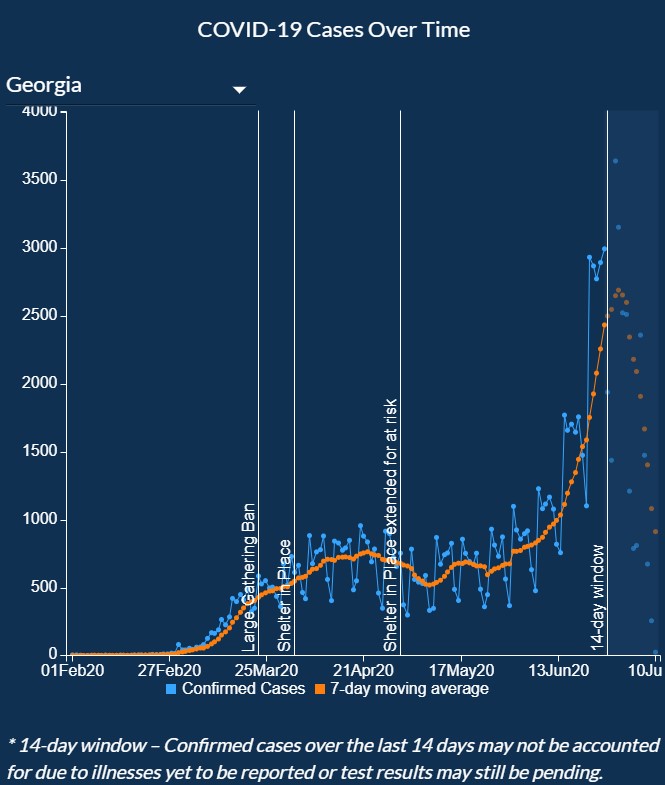
Keep your Eyes Peeled for the Second Wave: This requires good data, and right now, I’m not trusting Georgia’s data. Last week I reported how changing the way cases are recorded would result in the 14-day downward trajectory of COVID-19 cases Georgia needs to meet the Gating Criteria put forth in the Open American Up Again plan. That graph came out this week, and as Dunwoody resident Robert Wittenstein said, “It is more brazen and outrageous than I expected it to be. That sharp decline during the “14-day window” is a result of their backdating cases combined with our current protocols of only testing folks with symptoms.  If you are getting tested, it means you have symptoms, and if you have symptoms, it means you were infected over two weeks ago!” We data geeks need to hold our Georgia leadership accountable so that their desire to make “normal” their goal does lead to being blind to a second wave. We owe that to our healthcare workers too.

Clear Communication is Critical: I still participate in a weekly conference call with the Governor’s office. Sixteen questions are selected and turned in prior to each call. The last couple of weeks, the Governor’s staff has pretty much refused to answer many of these questions, to the point where it’s like, “why bother?”  Lots of room for improvement with this lesson.

Vote Like You Mean It

It’s 2020 — the year of the big November election we’ve all been working toward. But we can’t go out and register voters, we can’t host gatherings to nurture the communities we’ve all grown to love. So what do we do? Vote-by-Mail is a tremendous opportunity to change the way we vote, to a process that makes so much more sense to so many people. It’s still not as easy as it should be, but it’s basically the “hand-marked paper ballot” so many have been fighting for. So during the next couple of weeks, tell everyone you know, especially young people, to go to My Voter Page (remember, you bookmarked it) and to request a Vote-by-Mail ballot. Let’s see how many people we can get to vote this June, just like we increased voter turnout during the 2018 General Primary. This is how we “practice” for 2020.

Elections & COVID-19: A Virtual Town Hall

On Tuesday April 28, at 6pm, please join me, State Representative Beth Moore, and Gwinnett County Commissioner Ben Ku, for a public online program entitled “Elections & COVID-19: A Gwinnett Virtual Town Hall.”

Coronavirus has changed a lot of things, including the ways we safely and securely conduct our elections. We’ll  provide you with important updates and recommendations for best practices in the 2020 election cycle. This is a non-partisan event, and all district residents are invited to watch and submit questions.

You can tune in one of two ways:
(1) Watch the Facebook Live broadcast from my Facebook page; or
(2) Listen in by calling (301) 715-8592 and entering Meeting ID 926 3171 1369.

You can submit questions in advance by clicking on this Google Form link.

We’ve Only Just Begun

Now this is not the end. It is not even the beginning of the end. But it is, perhaps, the end of the beginning.
–Winston Churchill

The Governor’s About-Face

Almost two weeks ago, a beleaguered Governor Kemp, just back from visiting tornado-ravaged north Georgia, stood in front of the press to address Georgia’s response to the COVID pandemic. He was asked when he thought the economy could open back up. With an overwhelmed expression he said, “On the back side of this we can focus on opening up, but not yet.”

Seven days later, standing in front of the same press, he announced the reopening of businesses including gyms, salons, dine-in restaurants, tattoo parlors, and massage spas — all before the end of his April 30th Shelter-in-Place and May 13th Declaration of Emergency Orders.

Why this About-Face? Was it his phone call with Vice President Mike Pence? Was it his conference call with other southern, Republican governors? Was it the threat of a “Reopen GA Protest” at Georgia’s Capitol? Or was he following his heart and thinking this is the right thing to do?

During times of crisis we need the steady hand of reliable leaders. Instead, Gov. Kemp’s About-Face leaves us feeling like we don’t know what’s around the corner. His premature decision to say “yes” to non-essential massages, tattoos and haircuts, while still telling most of us to stay home except for necessities, makes no sense and does not inspire the kind of trust we need in a leader right now.

Orders for Re-Opening

This week the Whitehouse released “Opening Up America Again,” a very reasonable roadmap for balancing the opening of the economy and the health of Americans, as we wait for a treatment or vaccine to be developed. Even before activating the first of three phases, the report advises certain “gateway” criteria including 14-day declines in flu-like and COVID-19 symptoms and cases, adequate hospital beds, as well as PPE and testing for health workers. Has Georgia met these? No. This question was asked during this week’s legislative conference call with the Governor’s office:

What numbers changed to support the re-opening of Georgia businesses that was announced on Monday? The President’s reopening guidelines include a 14-day drop in cases before re-opening. What is the reasoning in re-opening before this has taken place?

Answer: “As the Governor said in his press conference on Monday, the state is on its way to meeting the gating criteria into Phase 1 of the “Opening up America” plan. We are beginning to see a plateau and slight decline in new case notifications and a decline in total death notifications.

“On its way” doesn’t cut it. Georgia does not meet the guidelines. And don’t be surprised if you see published graphs of declining cases to justify the Governor’s decision. According to the Atlanta Journal Constitution, new COVID-19 cases are now being recorded differently — instead of recording a new case when a test result comes back positive, the case is being recorded according to the date symptoms first appeared. This new way of documenting cases will result in a well-timed and misleading, temporary drop in case numbers. Many of us are relying on data to evaluate potential risks in venturing out — almost like looking at the weather forecast when planning trips. These changes in the numbers leave us feeling vulnerable and confused.

A Salute to Georgia’s Hospitals

Just a few weeks ago, we feared the United States would be “the next Italy” — that people would die because of a shortage of ventilators, and that a medical triage process would choose who lives and who dies. This did not happen in Georgia, due to the hard work of Georgia’s hospitals. Right now, possibly at the peak of our first COVID wave, we have over 900 available ICU units across Georgia. The cancellation of regularly scheduled procedures provided the necessary personnel, equipment and physical space so in-patient beds could be converted to ICU beds. Private healthcare systems worked cooperatively across healthcare systems to share resources, and a system of counting ER, ICU and in-patient beds was developed so the state could plan for the coming surge of patients. It all worked because of the sacrifices of so many people, from doctors who closed their businesses, to the healthcare workers who risked their own health to take care of others, to those of us who were staying home to slow down the spread, allowing our healthcare system the breathing room it needed. These numbers show that as long as there is not a resurgence of COVID-19 cases, hospitals can begin meeting pent up demand for elective procedures and surgeries. “Elective” in some cases means cancer treatments and people who are in disabling pain needing surgery.

April 24 Capacity In Use Available
ICU Beds 3,246 2,329 917
ER Beds 3,430 843 2,587
General Beds 14,727 9,169 5,558

source- Georgia Hospital Association

A Salute to Georgia’s National Guard

Forty percent of Georgia’s COVID-19 deaths are residents of long term care facilities. Over the course of the last three weeks, almost 3,000 soldiers, airmen, and State Defense Force personnel  have been deployed across Georgia to assist in the COVID-19 response. Most of these soldiers make up Infection Control Teams, who have visited 80% of the hundreds of nursing homes and long term care facilities in Georgia, doing deep cleaning, and training local staff on proper disinfection and infection control. General Tom Carden says that Georgia’s use of the National Guard in addressing the state’s COVID crisis is a model now being replicated in other states. Georgia’s National Guard is also assisting hospitals, food banks, school lunch delivery programs, and public health departments.

Does Georgia’s Testing Pass the Test?

Several constituents have been telling me from the beginning that it’s all about testing. Yet Georgia has been slow to get adequate testing rolled out. We’ve been told repetitively that testing will be “ramping” up, yet we continue to test less than 1% of Georgia’s population. In the last few weeks, we’ve slowly climbed from 45th to 43rd in the nation for people tested, as our daily testing numbers increased from around 3,000 to almost 7,000. Questions about testing came up in this week’s Governor’s conference call:

Will the testing the state is doing have both antibody testing and positive/negative test results? More information that we could share with constituents on this topic would be helpful.

Dr. Toomey responded: Initially, the tests that the state is administering are live virus tests run through PCR machines (positive/negative test). At this time, DPH is not administering antibody tests. This test shows exposure to COVID19 and may paint a better picture of the breadth of the virus at a time when access to adequate testing was limited. However, at this time we don’t know if the presence of antibodies necessarily shows immunity. The science isn’t there yet, so we wouldn’t rely on the presence of antibodies as firm evidence that a person is no longer at risk of being infected with COVID.

Dr. Toomey also referred to the CDC’s recent statement regarding the use of antibody testing: “The test is not currently designed to test individuals who want to know if they have been previously infected with COVID-19.”  (FDA letter to healthcare providers, and CDC Serology Testing)

During Monday’s press conference, Gen. Tom Carden was asked about the goals of Georgia’s testing program.

Gen. Carden responded: If you look at the rate of acceleration of our testing program during the last week (how much it has “ramped up”), Georgia is 28th out of 54 states and territories.  We are only limited by the supply of test kits and lab capacity. Our goal is to have enough testing to be able to make data driven decisions. We’re going to test what we can source for. “Trying to test almost 11 million people in the state of Georgia is about like trying to boil the ocean.”

When the press asked about measurable goals, Carden continuedThe top two testing states in the country, Rhode Island and NY, have both been able to test a little over 3% of their populations. Georgia is at 0.71%. I’d love to say Georgia could test 10%, but that’s not realistic. “My goal is to drive it until the system breaks.” 

Wherever the Virus Goes, We Go

Dr. Kathleen Toomey has said repetitively that contact tracing is how we are going to keep this virus under control. Yet she admits that the logistics of setting up a tracing system for a disease that is spreading so quickly through the population is not something that anyone in our current public health system has experience with. One constituent told me recently that he was exposed to the virus in early March through the wife of one of the early COVID patients. He was never contacted by public health, even though a contact tracing program was supposedly up and running.

What is the state’s plan for getting contact tracing up and running?

Here is Toomey’s response: The DPH is finalizing its plans for substantially increasing their capacity for contact tracing by significantly increasing staffing through partnerships with our higher education institutions and leveraging technology through a partnership with Google – more details will be shared in the coming days. It will take a village. Every public health epidemiology team will serve as incident commanders. We will have videos to train staff in the districts, to train volunteers. Other states built teams using Master of Public Health students, and medical students who are not currently in classes. When a person is newly infected, we will reach out, talk to them, find out with whom they were in contact and where did they go? We will address the exposures. In the past, we have done this manually with staff. Now with the wonder of Google technology, a computer based app is being finalized. It will be customized to our own needs. This is the priority in months ahead. This is how we keep spread from occurring even as we open up the economy. 

Four Week Chunks

So if we are just now approaching the end of the beginning, what’s next? I think we continue to protect ourselves and our healthcare system while we evaluate the impact of the Governor’s decisions the best we can. I’m carefully tracking hospitalization data because I feel it’s a pretty good measure of virus activity, and it’s not easy to manipulate. This data indicates we may have reached a plateau, and conference calls with major hospital systems support this data. For the most part, hospitals are reporting that they are discharging the same number of people they admit each day.

I told my kids, who are wondering if they will have in-person college classes in the fall or not, “you need to plan, then make contingency plans.” My friend Michael Murphy-McCarthy said, “I do well with four-week chunks.” Let’s see where we are in a few weeks, then we’ll ask “what’s next?” once again. In the meantime, check on your neighbors, donate to your local food bank if you can, and do whatever makes you feel good, within limits, of course!