What Happened on Sine Die? No One Really Knows
CLUSTER-bus bills
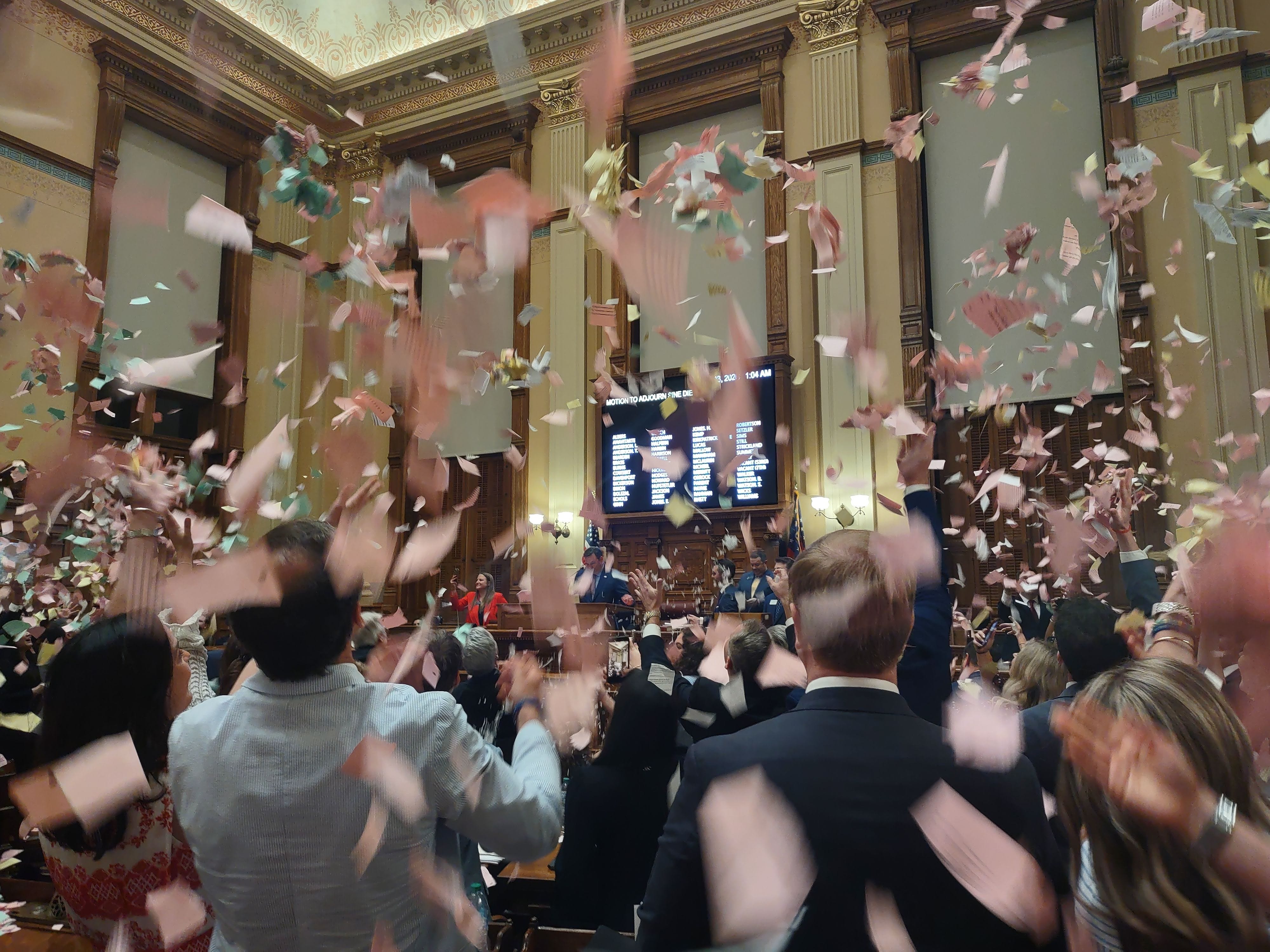
This year, Sine Die—the 40th and final day of the legislative session—technically ended at 1:05 a.m.. After going home to get some rest, I woke up and noticed a text from a Senate colleague that had been sent at 12:53 a.m:
“The House just voted down the new version of Senate Bill 447.”
That caught my attention. Anything happening that close to adjournment is usually significant. But I couldn’t remember what Senate Bill 447 was. When I looked it up, I saw that it started as a soil erosion bill—then the House sent it back as a mash-up of several different bills I recognized. But since the Georgia General Assembly website can’t keep up in real time, it will be several days before I can determine the last minute changes.
So I texted my colleagues: What was Senate Bill 447, and what did it become?
No one could answer.
Not one person in a group of experienced legislators knew what that bill had turned into or why it mattered in that moment.
We’re used to last-minute maneuvering on Sine Die. But this year was different. In my 14 years under the Gold Dome, I’ve never seen anything like it. The final hours were so chaotic that even one of my Republican colleagues took to the well and called it out. “What do you call this kind of stuff? I’ve heard y’all use terms like omnibus bill, I’ve heard Christmas tree bill — I call this a cluster-bus bill — that’s what this is — it’s a CLUSTER-bus bill, okay? I mean, it’s just that bad.”
As my Gwinnett colleague Senator Nikki Merritt said, “Last minute rider bills that no one can properly track have become an abuse of our legislative process. Winning at any cost is the goal, instead of good policy and transparency.”
Salvaging Core Campaign Messaging
We expected this legislative session to be all about campaign messaging. The Lt. Governor focused the Senate on eliminating income taxes; the Speaker focused the House on eliminating property taxes. In the end neither completely got their way, because in some instances, the legislative process actually worked.
In January, Speaker Jon Burns rolled out his property tax elimination bill. But this required a constitutional amendment, which required support from two-thirds of the body. Democrats stood firm and the bill failed.
So for weeks, House Republicans pushed HB 1116—the Speaker’s plan to cap property tax growth at 3%. But local governments warned they couldn’t function under that kind of restriction. And in a rare moment, enough Senate Republicans listened to their communities, and the bill failed.
But within minutes during the final hours of Sine Die, they stripped an unrelated bill—SB 33, a THC bill—and replaced it with a scaled-back property tax proposal. The bill was long and complex, and no one had time to read it.
They forced their campaign messaging through—no matter the cost. And when legislation moves that fast, the only responsible vote is no.
Voting Blind
And if the property tax scramble wasn’t enough, what happened with HB 297, and metro Atlanta’s ability to govern its own public transit, showed just how little the legislative process still matters.
HB 297 started out in the House as a bill that reclassifies multi purpose off-highway vehicles. But with only four session days left to go, the Senate Transportation Committee added language that greatly reduces the authority of the Atlanta-region Transportation Link Authority (ATL), renaming it the Transportation Efficiency Authority and changing the 31-member board to a nine-member board appointed by the Governor, Lt. Governor and Speaker of the House.
Senate Democrats spent several days pushing back on this bill, but at 12:38 p.m. on Sine Die, the bill came back from the House with more changes.
We weren’t even given a copy to read.
The Minority Whip made a Motion to Print. Senate Republicans objected—and voted the motion down.
No matter where you stand on transit, every Senator should be able to see a bill before voting on it. That’s the bare minimum. But on a bill that will determine the future of transit, even that standard wasn’t met.
One Duty Fulfilled…
Even in a chaotic final day, the one thing we are constitutionally required to do is pass a balanced budget. There were real concerns that negotiations might fall apart—but at 11:24 p.m., the final $38.5 billion budget for 2027 made it to the Senate floor.
Here are a few bright spots from the FY 2027 budget:
- Pay raises for teachers and state employees, along with long-awaited cost-of-living adjustments for state retirees
- 500 new NOW/COMP waivers for Georgians with disabilities
- Investments in literacy and early education, including funding for a literacy coach in every school and expanded Pre-K
- Mental health funding, including a new hospital and expanded services
It’s a big, consequential document—and one of the few things we got done the way we’re supposed to.
…Another Duty Squandered
This year, we had another job—and we didn’t get it done.
A law passed in 2024 requires Georgia to stop using QR code ballot systems by July 2026. That meant we needed to agree on a new way to count votes.
We didn’t.
All day Thursday, we were waiting on an election bill that never came. I remember sitting at my desk while a colleague gave a long farewell speech late into the night. A Senate doorkeeper leaned over and asked why we weren’t voting on bills.
I knew why. We were waiting on something that wasn’t going to happen.
The House passed one version, SB 214, delaying the deadline until 2028. The Senate pushed a sweeping bill requiring an immediate transition—something county officials warned could create chaos this close to a major election. Republicans couldn’t agree.
Now Georgia risks lawsuits, court orders, or even a special session. County election officials are left without clear direction, and the uncertainty will make their jobs harder at exactly the wrong time.
This should have been a straightforward fix. Instead, politics and conspiracy theories got in the way.
Falling in Line
Thursday morning my Republican colleagues followed their Governor’s orders to kill my bill to prevent birth defects by enriching corn masa flour with a critical B vitamin.
We know this works. When wheat flour was enriched with vitamin B9, babies born with spina bifida dropped by 30%. But Latino babies—whose families rely more on corn-based foods—are still twice as likely to be born with these conditions.
After my bill stalled, I successfully added it to another bill, HB 1138, expanding access to contraceptives. But this week, I was told the Governor would veto the entire bill if my language stayed—and that Republican leadership had the votes to strip it out.
I went to the floor (video below) determined to make sure my colleagues knew what they were doing when they voted on the amendment to “delete line 7 – 99.” I asked my Republican colleagues to vote their values—to preserve life, to protect babies, to reduce our state healthcare costs, and support families. All the things that Republicans say they care deeply about.
Only one did.
It was a stark reminder that too often, the influence of party pressure, lobbying, and money win out over good policy—even when the stakes are this clear.
What’s Next?
I’ll be sending another Snapshot soon with a full rundown of what passed and what didn’t. I just need a few days to figure it out. Hopefully I can!
Call to Action
In the meantime, there’s something all of us can do: support leaders who care more about good policy than political games.
Primary elections are this May. I’ve endorsed Jason Esteves for Governor and Josh McLaurin for Lt. Governor—leaders who are committed to doing things the right way.
Support candidates with your money and time who want to move Georgia forward (I’ll provide you some updates). Volunteer. Get involved. And most importantly—vote and get others to vote.
P.S. Now that session is over, I can accept campaign contributions again. I have an opponent this fall, and I can’t take anything for granted. I will also be financially supporting candidates in other districts that we can flip. Donate at this link https://secure.actblue.com/contribute/page/sallyharrell-sd40