2026 Legislative Wrap-Up vs. Why Elections Matter
If you’re one of my regular readers, you’re likely intrigued by “how things go down” at the Gold Dome — the interplay of power, personalities, and parliamentary procedures. That curtain has now closed, and this edition of my Snapshot focuses on the big themes of what survived and what didn’t (and yes, SB 154 failed, so you’ll need to keep changing your clocks to spring forward and fall back). This is a longer than usual newsletter. Read what’s relevant to you!
The real Final Act is our pending election. When I’m out in public and people bring up the election in conversation, I tend to just look at them and say, “Well, it’s either going to get better or worse.” To me, visualizing doomsday scenarios really isn’t helpful, because if things get worse, we’ll deal with it, just like we have been. Personally, I’d rather focus on making things better.
Early voting starts Monday, and it’s a long, intimidating ballot — even for me and my friends who are super involved! Here’s some advice to get you started:
Personal Endorsements: I have endorsed three state-wide candidates. Jason Esteves for Governor, Josh McLauren for Lt. Governor and Bret Hulme for Labor Commissioner. I know all three of these candidates personally and I know they have what it takes to lead.
Friends that I respect and who have done their homework are voting for the following for statewide offices: Agriculture — Sedrick Rowe; Insurance — DeAndre Mathis or Clarence Blalock; Public Service Commission — Craig Cupid; and Attorney General — Tanya Miller or Bob Trammel (both are great, I wish I didn’t have to choose between them). For those of you in DeKalb, Sonja Szubski for DeKalb School Board.
Candidate Forums: The DeKalb Dems have done an excellent job at organizing candidate forums. Here are three links that allow you to see the candidates in action. You might pay close attention to the State School Superintendent race.
- Agriculture, State School Superintendent, Public Service Commissioner
- Lt. Governor, Commissioner of Insurance
- Commissioner of Labor
And about those judges? I find this Georgia Justice Project website to be helpful. These races are non-partisan, so you can’t depend on looking for “D” and “R” on the ballot to help you choose. You must remember their names or bring a cheatsheet. Also, remember that these races aren’t primaries and the results are final. We have two Democrats running for the Georgia Supreme Court — Miracle Rankin and former State Sen. Jen Jordan. For the Court of Appeals, the candidates running against conservative judges are Will Wooten and Fatima Harris Felton.
2026 Legislative Session Wrap-Up
Note: The Governor has 40 days from Sine Die to veto bills, so that makes the deadline May 12th. If the Governor neither signs nor vetoes a bill, it becomes law without a signature.
Tax Relief vs. Tax Shift
Georgia Republicans made big promises on taxes, but the results were much smaller. Senate Republicans talked about eliminating the income tax, and House Republicans promised to wipe out property taxes. What actually passed was far more limited: HB 463 lowers the income tax rate from 5.19% to 4.99% this year, with a potential path to 3.99% over time, and SB 33 caps property assessment growth while allowing local governments to ask voters for a new sales tax to make up the difference.
That’s not a tax-cut revolution—it’s a tax shift. Instead of reducing the overall burden, it moves costs onto sales taxes paid for by all local residents, including renters and future homeowners, while local governments are left trying to fund schools, public safety, and basic services with fewer reliable dollars.
SB 33 has another fatal flaw: Because Republican leadership couldn’t agree on their competing tax plans until the final minutes of Sine Die, at the last minute, the Senate stripped SB 33 of its original contents and replaced it with the final tax package. The Georgia Constitution requires that revenue-raising bills originate in the House, not the Senate. That means this bill is almost certain to face a court challenge if the Governor signs it.
Protecting Kids vs. Protecting Big Tech
Going into this session, I was hopeful. The Senate Republican Caucus made online safety for kids a top priority, and after co-chairing the Online Safety Study Committee last fall, we had real momentum. Together, we filed strong bills: SB 495 to reduce addictive online features, SB 488 to hold AI platforms accountable under Georgia’s product liability law, and SB 467 to require parental permission before minors download apps.
But when it came time to act, the only bill leadership allowed to advance was SB 540, a last minute bill sponsored by the Senate Majority Leader. It started as a tech industry model bill (have I mentioned that the Majority Whip’s wife is Meta’s top lobbyist in Georgia?) —full of vague language and big loopholes. Thankfully I was able to work with the Majority Leader’s office and the Chair of the House Technology Committee to significantly strengthen it. As passed, SB 540 requires safeguards for kids interacting with AI chatbots, including clearer disclosures, limits on harmful or deceptive interactions, and stronger accountability when those systems cause harm.
It’s a step forward—but a small one. One other Study Committee recommendation did make it through: HB 1009, which bans cell phones bell-to-bell in high schools, is now awaiting the Governor’s signature.
Local Control vs. Controlling Locals
For years, we’ve heard Republicans champion “local control”—the idea that communities know best how to govern themselves. But this session, that principle didn’t apply to metro Atlanta. We saw a wave of legislation aimed squarely at metro Atlanta counties, shifting power away from local leaders and voters back to the state.
County Election Takeover (HB 396)
Converts county elections from partisan to nonpartisan—but only in five major metro counties: Fulton, DeKalb, Cobb, Clayton, and Gwinnett. These are Democratic strongholds, and stripping party labels from the ballot makes it harder for voters to identify candidates—widely seen as a naked power grab to give Republicans a better shot at winning local offices.
MARTA Takeover (HB 297)
Combines multiple regional transit entities into a single, new governing structure and puts it under a board largely appointed by state leaders. In simple terms, it merges existing transit oversight bodies and shifts decision-making power away from local governments to a state-controlled board, reducing the influence of the counties and cities that rely on—and pay for—transit.
Transit Restrictions & Referendum Limits (HB 328)
Limits how local transit dollars can be used—banning reduced or free fares—and restricts how often voters can revisit transit funding referenda. This was driven in large part by Gwinnett Republicans seeking to control how frequently voters can weigh in on MARTA expansion, tying the hands of local communities and voters trying to make their own transit decisions.
Lawsuits Against Local Governments (HB 295)
Allows individuals—including renters—to sue their local government over policies related to homelessness or so-called “sanctuary” practices, exposing cities and counties to frivolous and costly litigation for how they manage local challenges.
Education: Mostly Good with a Bit of Bad
I frequently hear seasoned legislators remind constituents that the majority of bills passed by the Georgia legislature are not politically contentious, even if the media makes it seem that way. This was true with education bills this session.
Literacy Coaches: The shining light in terms of education policy was HB 1193, the Georgia Early Literacy Act, which will provide the resources to schools to hire literacy coaches who will use research based methods to address literacy challenges. With 62% of third graders not reading at proficiency level, these resources are necessary. Children who are not reading a grade level by third grade are at higher risk of dropping out before finishing high school.
Needs-Based Scholarship: $350 million dollars was allocated in the budget to initiate a needs-based scholarship for kids who can’t afford tuition and living expenses. This will fill a gap, helping kids who might fall short of qualifying for the HOPE scholarship, but who show potential and motivation.
Private School Tax Credit: HB 328 continues the Republican trend of raising the annual cap for private school tax credits that siphon tax dollars away from public schools.
Take ACTION!!! If you are currently utilizing the Georgia GOAL tax credit, consider using the PEACH Education Tax Credit instead, which sends dollars to public schools instead of private schools. Doing this is an act of resistance!
Data Centers: Angry Georgians vs. Georgia Power
At the beginning of the legislative session, it seemed like one thing all could agree on is that everyone hates data centers. Over 20 pieces of legislation were filed to reign in on data center growth and increase transparency, but none of them passed. Big Tech and Georgia Power ought to be delighted.
Data Center Tax Breaks: Two bills, SB 408 and 410, proposed to end tax breaks for data centers, which are currently leading Georgia to lose up to $3 billion in tax revenue through 2027. Without further action, Georgia’s Data Center tax break will stay in place through 2032.
Infrastructure Price Tag: SB 34 originally attempted to protect rate payers from footing the bill for the rising costs of data center expansion. Georgia Power would have you believe that data centers are paying their way, but if that were true, it would have been no big deal for them to have supported this bill. Now they’re rolling out T.V. commercials telling you how fortunate we are that data centers are reducing your power bills. Don’t believe it.
Increasing Transparency: Even modest proposals like requiring mandatory disclosures about how much water and electricity data centers use, and blocking local governments from signing nondisclosure agreements that keep deals secret did not make it to the Governor’s desk.
Elections Matter, Especially this Year
Even if we don’t flip the Georgia House (which we could) or the Georgia Senate (which we probably can’t), winning the Governor’s office is within reach. We have Democratic candidates running in over 80% of Georgia’s House & Senate districts. Even if they can’t win because of gerrymandered districts, every vote they get is also a vote for the Governor’s race.
I can tell you from personal experience, winning the Governor’s office would change the legislature, even if we don’t flip the chambers. Think about the veto power of the Governor. No longer would the gates be wide open for far-right legislation, because a Democratic Governor could veto it. Then the Republicans, who have been blocking almost all Democratic bills, would have to come to the negotiating table and actually negotiate.
This is huge. Once the primary and run-offs are over and we know who our candidates are, the work begins. I’ve been writing checks to candidates who are running good races to flip districts so that as our power increases we have good team players. Please consider donating to my campaign so I can continue to provide targeted support to others, and so I can get ready for my November campaign.
I’ll stay in touch — maybe not every week, but as necessary along the way. For example, I’ll let you know if the Governor calls a special session to deal with the 2024 law about not using QR codes to count ballots
Until then, take care of each other and remember that every act of kindness is an act of resistance.
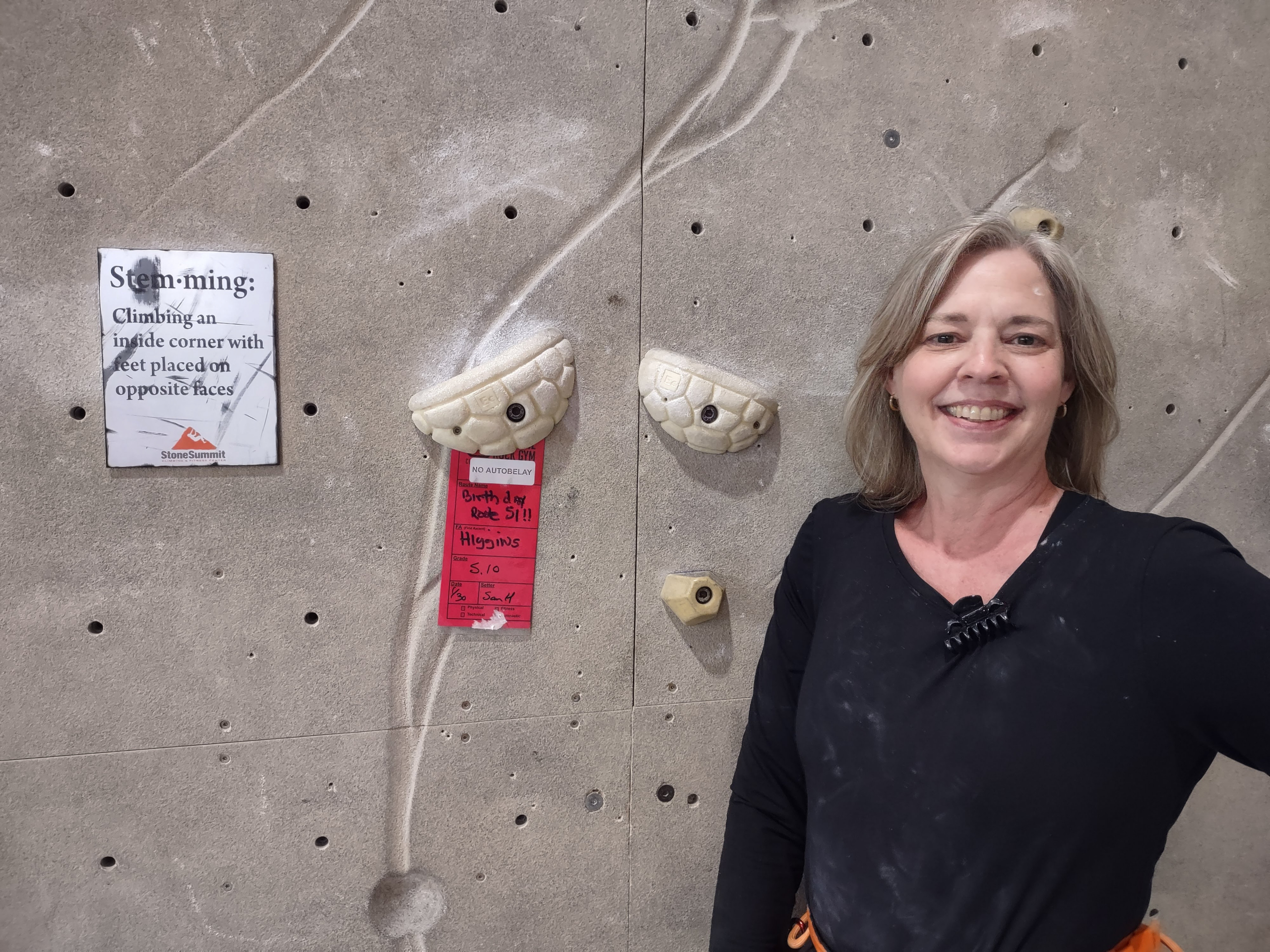
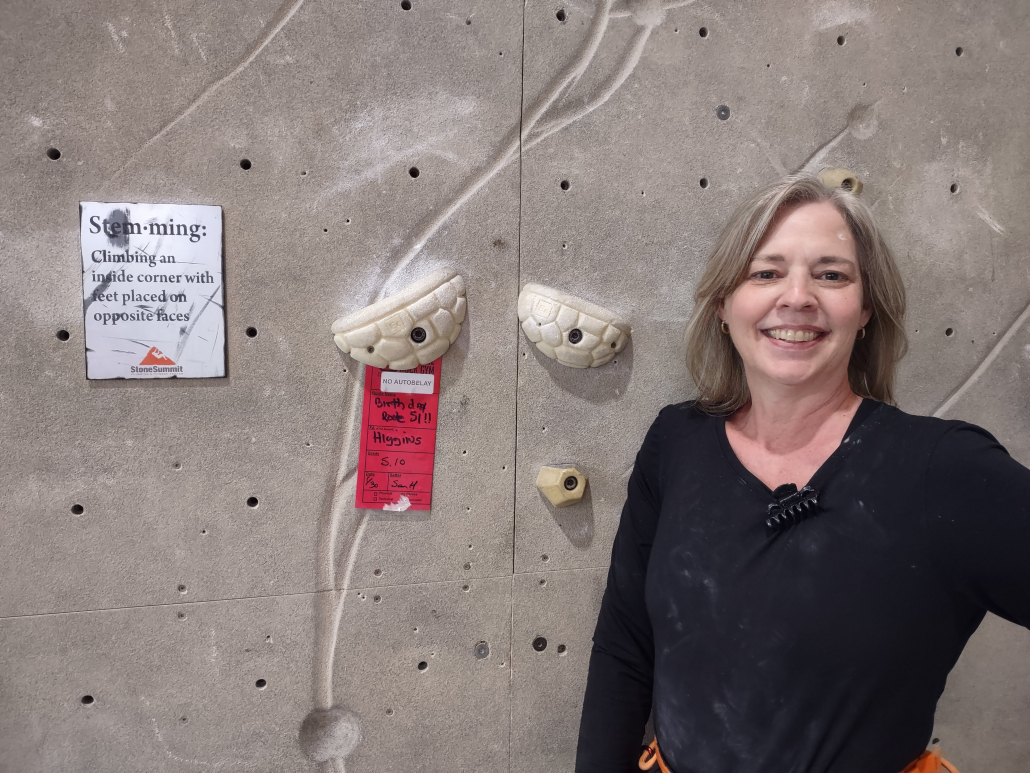
When we experience stress, our bodies are designed to run, but in reality, modern life stress often requires us to sit still. I did a lot of sitting still during the legislative session, so my first goal after Sine Die was to get moving to help work out those pent up frustrations. I always take a moment to celebrate when I do my first climb rated 5.10 (level of difficulty) after I’ve been away for a while — I’m back at the top of my game again!